Introduction
The average distributor operating profit sits at just 4%, according to the National Association of Wholesaler-Distributors. A single poorly priced contract, an unchecked sales rep discount, or a missed cost increase can wipe out profitability on thousands of transactions before anyone notices.
That's what makes pricing so consequential. Pricing isn't a one-time markup decision — it's an ongoing operational discipline running across every SKU, every customer, and every sales channel at once.
This guide covers what distributor price management involves, how to calculate distributor prices using the right formulas, which pricing strategies work best for which situations, the operational pitfalls that erode margins quietly, and the practices that protect profitability at scale.
Key Takeaways
- Average distributor operating margins are around 4%—small pricing errors compound fast across thousands of transactions
- Markup and margin are not the same calculation; confusing them leads to systematic underpricing
- Uncontrolled discounting is the single biggest margin leak in distribution, affecting 20–50% of transactions
- Distributor pricing requires multiple simultaneous strategies: contract, volume, segment, and promotional pricing working together, not a single flat markup
- Real-time analytics and ERP-integrated pricing controls give distributors the visibility to catch margin leaks before they compound
What Is Distributor Price Management?
Distributor price management is the structured process of setting, adjusting, monitoring, and controlling prices across products, customers, and sales channels. The key word is process—not policy, not formula, not gut instinct.
For distributors, the stakes are unusually high. With average operating profit at just 4%, McKinsey research shows that a 1% price increase would yield a 22% increase in EBITDA margins—a 25% uplift in stock price, and a 20% increase in enterprise value. No other operational improvement comes close to that leverage.
The same research found that distributors undertaking end-to-end pricing transformations can expand earnings by up to 50%—with best-in-class organizations achieving 200 to 500 basis point margin improvements. For a business running on 4% margins, that's the difference between surviving on volume and actually building profitability.
Distributor Pricing vs. Wholesale Pricing
These terms overlap in casual use, but they describe different commercial relationships:
- Wholesale pricing — A flat discount for bulk resale buyers; no added services, no territory obligations.
- Distributor pricing — A contract-based model that compensates partners for territory management, logistics, marketing support, and customer development.
Because distributors carry more of the supply chain burden, they receive steeper discounts—but they're also held to volume commitments, territory agreements, and performance expectations. NAW identifies the core mechanisms that make this work:
- Customer-specific pricing agreements
- Pricing matrices and pricing bands
- Pricing floors
- ERP-based contract pricing
Wholesale pricing uses none of that infrastructure.
How to Calculate Distributor Price
There's no universal formula here. The right calculation depends on the pricing model you're using.
The Cost-Plus Formula
Cost-plus is the most common starting point:
Distributor Price = Cost of Goods + (Cost of Goods × Markup %)
Example: A product costs $50. With a 30% markup, the distributor price is $65.
Cost-plus works well for stable commodity products where costs are predictable and competition sets the ceiling.
Its weakness: applied uniformly across an entire catalog, it ignores demand variation, competitive positioning, and customer price sensitivity. High-value SKUs get underpriced while commodity lines get overpriced.
Markup vs. Margin: Understanding the Difference
This distinction trips up more distributors than almost anything else in pricing.
- Markup % = (Price − Cost) ÷ Cost × 100
- Gross Margin % = (Price − Cost) ÷ Price × 100
Using the $50 cost / $65 price example:
- Markup = ($65 − $50) ÷ $50 × 100 = 30%
- Gross Margin = ($65 − $50) ÷ $65 × 100 = 23.1%
A 30% markup produces a 23.1% gross margin, not 30%. If your minimum profitability target is expressed as a gross margin percentage and your team is thinking in markup terms, you're systematically underpricing across your entire catalog.
The fix is straightforward: set floor targets in margin terms, price in markup terms, and convert before you finalize.
Average Markup Ranges by Industry
Distributor markups vary widely by sector, driven by product complexity, competition intensity, and the value-add the distributor provides:
| Sector | Approximate Gross Margin Range |
|---|---|
| Grocery/food distribution | ~2–3% (high volume, thin spread) |
| Industrial/MRO supply | ~3–15% |
| Electrical equipment | ~10–20% (compressed by volume pricing) |
| Safety supplies | ~20–40% for specialized items |
| Medical/healthcare distribution | ~20–40% for specialized products |
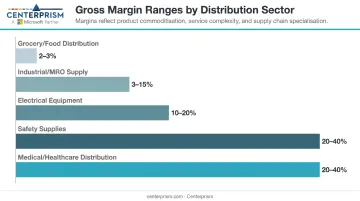
Factors that compress margins: intense competition, commodity-heavy catalogs, high customer price sensitivity, and low switching costs. Factors that expand them: technical complexity, specialized supply, exclusive territories, and meaningful distributor value-add.
Key Pricing Strategies for Distributors
Successful distributors don't pick one pricing approach. They run multiple models simultaneously—applied to the right customers, products, and situations.
Customer-Specific and Contract Pricing
Contract pricing locks in negotiated rates for specific accounts based on purchase volume, account tenure, or strategic importance. Done well, it:
- Reduces churn by building pricing predictability for both sides
- Rewards your most valuable accounts without discounting broadly
- Creates clear renewal triggers tied to expiration dates and volume thresholds
The operational risk: contracts without defined review dates get forgotten. Supplier costs change. The original margin on a three-year-old contract may now be negative. Build automatic expiration alerts and review triggers into your process from the start.
Quantity Break Pricing
Tiered volume discounts—5% off at 10 units, 10% off at 50, 15% off at 100+—incentivize larger orders, improve inventory turnover, and increase average transaction value.
The discipline required: every discount threshold needs to be validated against a minimum margin floor. If your 15% volume discount pushes a product below your floor margin for that category, the threshold needs to move or the base price needs adjustment. Volume discounts that feel generous but actually destroy margin are common and preventable.
Margin-Based and Segment Pricing
Instead of starting with cost and adding a markup, margin-based pricing starts with a target gross margin and works backwards to the selling price:
Selling Price = Cost ÷ (1 − Target Margin %)
Segment pricing groups customers with similar buying behavior and price sensitivity, then applies consistent pricing logic within each group. It scales better than negotiating every account individually, reduces pricing inconsistency, and makes outliers easier to spot.
Promotional and Clearance Pricing
Time-limited promotions, seasonal discounts, vendor-funded deals, and clearance pricing for slow-moving inventory all serve legitimate purposes—but only when controlled.
Every promotional price needs:
- A defined start and end date
- A minimum margin floor that cannot be breached
- Clear documentation of whether the discount is vendor-funded or self-funded
Without those controls, promotional pricing bleeds into everyday pricing through rep habits and customer expectations.
Common Challenges in Managing Distributor Prices
Well-designed pricing strategies break down without operational controls. These are the failure points that show up most often.
Uncontrolled Discounting and Margin Erosion
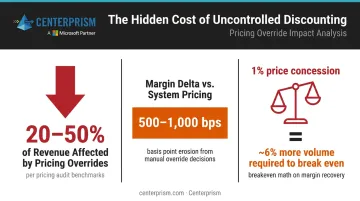
NAW research puts the scale of this problem in sharp relief: pricing overrides account for 20% to 50% of revenue, with a margin delta of 500 to 1,000 basis points versus system pricing. That means a distributor operating at 18% gross margin who gives a 1% price concession needs roughly 6% more volume just to break even on that deal.
Sales reps under competitive pressure grant ad-hoc discounts. Those discounts get recorded as "last price paid," and the system defaults to that lower price on the next order. Repeated across thousands of transactions, the erosion builds faster than most teams realize.
Without minimum margin thresholds and approval workflows, discounting stops being a strategic tool and becomes a reflex.
Price Inconsistency Across Customers and Channels
When one customer discovers another is paying significantly less for identical products—or when the ecommerce channel undercuts field sales pricing—trust breaks down fast. Complaints follow, relationships deteriorate, and MAP policy violations can create friction with suppliers.
The source is usually fragmented pricing management: different reps applying different logic, no centralized pricing governance, and no systematic review of what's actually going out the door.
Pricing Complexity at Scale
Managing thousands of SKUs across multiple customer tiers, active contracts, and concurrent promotions isn't a spreadsheet problem—it's a systems problem. A 2023 MDM/White Cup survey found that 80.4% of distributors still use spreadsheets for data management, yet 92% view data analytics as critical for their business. Only 8.9% identified as analytics leaders.
That gap—between recognizing the need and having the capability to act on it—is where pricing decisions get made on instinct rather than data, and where margin quietly walks out the door.
Best Practices for Effective Distributor Price Management
Set and Enforce Minimum Margin Thresholds
Define non-negotiable floor margins by product category and customer type. Any pricing that falls below the floor should require management sign-off. NAW specifically recommends integrating pricing bands and floors directly into ERP and CRM order entry to prevent override-driven leakage.
This doesn't eliminate flexibility for legitimate competitive situations—it just ensures someone with authority reviews them before they become habits.
Segment Customers and Price Accordingly
Group customers by purchase volume, industry, service requirements, and price sensitivity. Apply consistent pricing logic within each segment rather than negotiating every account from scratch. This approach:
- Scales without adding pricing overhead
- Reduces inconsistency across sales reps
- Makes pricing performance easier to monitor and audit
Use Real-Time Analytics to Monitor Pricing Performance
Waiting for month-end reports to spot a margin problem means decisions are already running on stale data. Centerprism's PrismView connects directly to the live Dynamics GP database with no separate BI database required, giving distributors real-time access to profit margins, sales trends, and best-seller performance without exporting data that's outdated the moment it leaves the system.
When a pricing error happens, it's visible immediately — before more orders ship at the wrong price.
Establish a Regular Pricing Review Cadence
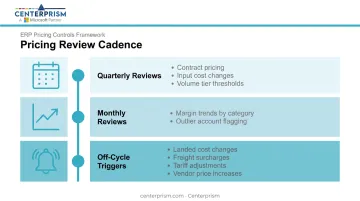
McKinsey recommends shifting from annual or semiannual pricing reviews to monthly or quarterly cycles in volatile conditions. A practical cadence:
- Quarterly: Review contract pricing, input cost changes, and volume tier thresholds
- Monthly: Review margin trends by category and flag outlier accounts
- Off-cycle triggers: Landed cost changes, freight surcharges, tariff adjustments, or vendor price increases
Don't wait for customer pushback to discover a margin problem. By then, it's already compounded.
Automate Pricing in Your ERP System
Integrating pricing rules, customer-specific contracts, promotional schedules, and margin controls directly into ERP eliminates the manual errors that spreadsheet-based pricing creates. According to NAW, distributors at the most advanced pricing maturity stage—with integrated, adaptive pricing systems—outperform peers by 400 to 800 basis points.
Centerprism's Price Management and Price Memorization modules centralize customer pricing, discounts, and promotions, storing customer-specific rules so negotiated rates apply automatically at order entry. Combined with PrismView's real-time margin visibility, distributors get both the guardrails and the reporting needed to catch pricing problems before they compound.
Frequently Asked Questions
What is the average markup for a distributor?
Average distributor markups typically range from 10% to 40%, depending on industry, product complexity, and the value-add the distributor provides. Commodity-heavy sectors like grocery or industrial supply sit at the lower end, while specialized categories like medical equipment or safety supplies can reach the higher range.
How do you calculate distributor price?
The cost-plus formula is: Distributor Price = Cost × (1 + Markup %). Margin-based pricing works backwards from a target gross margin: Selling Price = Cost ÷ (1 − Target Margin %). Which formula to use depends on whether you're protecting margin percentages or hitting specific price points in the market.
What are the main pricing strategies for distributors?
The core strategies are contract/customer-specific pricing, quantity break pricing, margin-based pricing, segment pricing, and promotional pricing. Most distributors apply several of these simultaneously across different products and customer types.
What is the difference between distributor pricing and wholesale pricing?
Wholesale pricing is a flat bulk discount for resale buyers with minimal added services. Distributor pricing is a deeper, contract-based model that compensates partners for carrying logistics, territory management, and marketing or technical service responsibilities. In exchange, distributors typically receive steeper discounts than standard wholesale buyers.
What causes margin erosion for distributors?
The most common causes are uncontrolled ad-hoc discounting by sales reps, failure to enforce minimum margin thresholds, inconsistent pricing across channels or customers, and contract pricing that hasn't been updated to reflect supplier cost increases.
How does ERP software help with distributor price management?
ERP systems centralize pricing rules, enforce customer-specific contracts at order entry, and apply margin floor controls automatically. Real-time reporting surfaces pricing problems before they compound, while audit trails track who changed what—keeping sales teams accountable. Centerprism's PrismView delivers this visibility without requiring a separate database or manual spreadsheet exports.