The U.S. Electrical Equipment Wholesaling industry reached $264.2 billion in 2026 according to IBISWorld, yet many distributors still manage inventory through spreadsheets and gut instinct. The gap between that approach and what's actually needed is where stockouts happen, orders fall through, and accounts walk.
This guide covers the specific challenges electrical distributors face, a five-step inventory management process you can standardize, proven strategies including the 80/20 rule, and what connected order management actually looks like in practice.
Who this is for: Purchasing managers, operations leaders, and owners at electrical distribution companies ready to move beyond reactive stock management.
Key Takeaways
- Electrical distributors deal with SKU complexity and project-driven demand spikes that generic inventory approaches can't handle
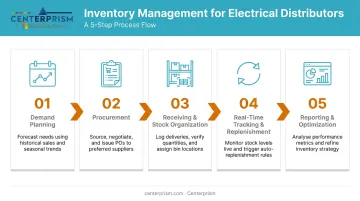
- A five-step process—plan, procure, receive, track, optimize—creates repeatable control across your inventory cycle
- The 80/20 rule focuses capital on the 20% of SKUs generating most of your revenue
- Without shared live data between inventory and order management, overselling and backorders become inevitable
- Purpose-built ERP systems turn real-time inventory and order data into decisions, not just reports
What Makes Inventory & Order Management Uniquely Challenging for Electrical Distributors
Distribution inventory management is the systematic process of purchasing, storing, tracking, and fulfilling products across your locations to meet customer demand. For electrical distributors, the operational reality goes well beyond that definition.
The SKU Complexity Problem
Electrical product lines are dense with variation. A single wire product—12 AWG THHN, for example—comes in multiple colors, spool sizes, and jacket types. Multiply that across breakers, conduit, fittings, panels, and specialty items, and a mid-size distributor is managing tens of thousands of individual SKUs with overlapping specs, multiple manufacturers, and inconsistent lead times.
Manual tracking at that scale isn't just inefficient—it's error-prone by design. And errors in inventory data have downstream consequences: wrong counts create phantom stock, which causes fulfillment failures at the worst possible moment.
Demand Volatility and Carrying Cost Pressure
Project-driven demand from electrical contractors creates unpredictable spikes. A large commercial build-out might require bulk wire and panels delivered on a tight construction timeline, while those same items sit untouched for weeks before and after. Meanwhile, specialty items accumulate on warehouse shelves, tying up capital.
According to MDM, one-third of distributors in a 2023 survey reported inventory data accuracy below 95%—a significant gap when standard customer service level goals for distributors run between 95% and 97%, with critical items requiring 99.5% availability.
Order Management Pressure and the Multi-Location Challenge
Customers expect accurate order status, fast fulfillment, and no surprises. When inventory data lives in a separate system from order management—or worse, in a spreadsheet—staff are manually cross-checking availability while orders queue up. That process breaks under volume.
For distributors running multiple branches, the problem compounds. One location sits overstocked on 200A panels while another back-orders the same item. The result is a predictable set of costly workarounds:
- Emergency calls to suppliers to cover gaps
- Rush freight charges that erode margins
- Service failures that damage customer relationships
The 5-Step Inventory Management Process for Electrical Distributors
Before adding technology on top of your inventory operation, standardize the process. These five steps form a repeatable loop that reduces both stockouts and excess inventory.
Step 1: Demand Planning and Forecasting
Demand planning means analyzing historical sales data, project pipelines, and seasonal patterns to anticipate what you'll need and when. For electrical distributors, that means tracking contractor project schedules, construction activity in your region, and which product categories follow seasonal cycles.
MDM notes that forecast error—the gap between predicted and actual demand—directly pressures distributor cash flow. Even modest improvements in forecast accuracy reduce both emergency buys and excess stock at once. The goal isn't perfect prediction; it's reducing the range of your misses.
Step 2: Procurement and Purchase Order Management
Disciplined procurement ties reorder points and vendor lead times to purchase order creation. When those connections are explicit and visible, you stop placing emergency orders because something ran out unexpectedly. You also stop over-buying because a sales rep assumed demand was higher than it was.
Key procurement discipline points:
- Set reorder points based on actual lead time data per vendor, not estimates
- Consolidate vendors where possible to improve contract pricing and order terms
- Track open POs against expected arrival dates so receiving teams aren't surprised
Step 3: Receiving and Stock Organization
Receiving is where inventory accuracy is either established or destroyed. Every item that comes in needs to be logged by SKU, verified against the purchase order, and placed in a designated location.
Errors here compound fast. A miscounted receipt creates phantom inventory—stock the system believes exists but doesn't. When a customer order for that item fails weeks later, the root cause won't be obvious until someone physically walks the warehouse.
Organized receiving means:
- Scanning or logging each item against the originating PO
- Flagging discrepancies before closing the receipt
- Assigning bin or shelf locations consistently from day one
Step 4: Real-Time Tracking and Automated Replenishment
Accurate receiving sets the baseline — but keeping that accuracy intact across thousands of SKUs requires automation. Setting minimum stock thresholds per item and automating reorder triggers removes the need for constant manual oversight.
Real-time tracking across locations solves a different problem: it eliminates phantom stock. When your system shows 50 units of 1" EMT conduit at Branch A, that number needs to be accurate—not a stale count from last week's manual check. Systems with live inventory updates make that possible.
Effective real-time tracking includes:
- Live stock counts updated at point of transaction, not end-of-day
- Multi-location visibility so staff can check branch inventory without phone calls
- Automated reorder alerts triggered at predefined minimums per SKU
Step 5: Reporting, KPI Review, and Continuous Optimization
The metrics that matter for electrical distributors:
| KPI | What It Tells You |
|---|---|
| Inventory turnover rate | How efficiently you're cycling stock |
| Fill rate | What percentage of orders ship complete and on time |
| Days of supply | How long current stock lasts at current demand |
| Carrying cost % | What it costs to hold inventory relative to its value |
Quarterly reviews using these metrics surface slow-moving items accumulating on shelves, identify your actual best sellers versus assumed ones, and catch margin leaks before they become a pattern. This step closes the loop and feeds back into better demand planning.
Proven Inventory Strategies Every Electrical Distributor Should Use
Apply the 80/20 Rule to Your SKU Portfolio
Roughly 80% of your revenue comes from 20% of your SKUs. For electrical distributors, this translates directly into an ABC classification framework:
- A-items: High-velocity, high-revenue SKUs (12 AWG THHN wire, 20A breakers, standard conduit sizes). Prioritize capital, shelf space, and reorder attention here.
- B-items: Moderate velocity, moderate margin. Monitor regularly but don't overstock.
- C-items: Low velocity, specialty items. Set tighter controls, consider just-in-time ordering, and review whether continued stocking makes sense.
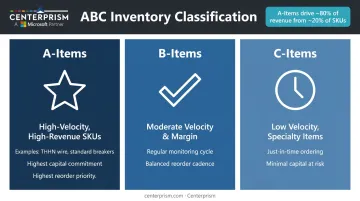
The 80/20 rule doesn't mean ignoring C-items—some specialty products are high-margin or critical to key accounts. It means your systems and attention are calibrated to where the money actually flows.
Use Cycle Counts Instead of Annual Physical Counts
Annual physical inventory counts require shutting down operations, consume significant labor, and only give you a snapshot accurate for that single day. Cycle counting—counting a rotating subset of SKUs on a regular schedule—keeps inventory data accurate year-round without the disruption.
Count A-items monthly, B-items quarterly, C-items semi-annually. Discrepancies caught during cycle counts get corrected before they cause fulfillment failures.
Set Calculated Reorder Points, Not Gut-Feel Minimums
The formula is straightforward:
Reorder Point = (Average Daily Usage × Supplier Lead Time) + Safety Stock
Arbitrary round numbers—"let's keep 50 of everything"—produce unnecessary overstock on slow items and stockouts on fast ones. Calculated reorder points sized to actual usage patterns and lead time data prevent both.
Standardize Branch Inventory Transfers
Multi-location distributors need a clear, system-supported process for moving stock between branches:
- Identify the need — one branch flags low stock on a specific SKU
- Check availability — system confirms surplus at another location
- Initiate transfer request — with approval workflow
- Update both records — inventory decremented at source, incremented at destination simultaneously
Skip this process and the default outcome is a duplicate supplier order: more freight spend, more incoming stock, and the same underlying imbalance between branches.
Connecting Inventory to Order Management: The Fulfillment Loop
Inventory management and order management are the same operation split across two functions. When they run on separate systems, the gaps surface directly in customer service failures.
The right connection looks like this: a customer order draws against live inventory data at the moment it's placed. If stock is available, the order confirms and inventory is reserved. If it's not, a backorder flag triggers immediately—before the order ships short, not after.
What Breaks When They're Disconnected
When inventory and order management run in separate systems—or when staff manually reconcile between them—several problems become routine:
- Accepting orders for stock that isn't actually available
- Discovering shortages at pick time instead of at order entry
- Multiple staff members placing duplicate replenishment orders independently
- Fielding status calls that no one can answer accurately
McKinsey's 2024 B2B research found that more than 50% of B2B buyers will switch suppliers if they don't receive a consistent, accurate experience. Order accuracy and visibility are no longer differentiators—they're baseline expectations.
What Integration Looks Like in Practice
The order management capabilities that need to share live inventory data:
- Customer order history and pricing tiers, so reps quote accurately at order entry
- Purchase order creation and vendor tracking tied to actual demand, not estimates
- Backorder management with structured customer communication workflows
- Automated order confirmations drawn from live stock levels
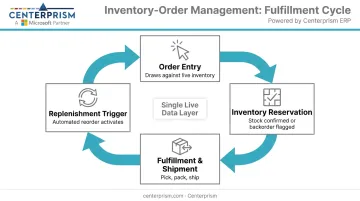
When these functions share a single data layer, the entire order cycle—from entry to fulfillment to replenishment—runs on the same real-time record. There's no reconciliation step, and no gap for errors to hide in.
What to Look for in an ERP System Built for Electrical Distributors
Basic inventory software works until it doesn't. As SKU count, order volume, and branch complexity grow, the gaps between what your system can do and what your operation needs get expensive fast.
A purpose-built ERP for electrical distribution connects inventory, order management, purchasing, customer management, and financial reporting in one system. That integration is what makes real-time decisions possible instead of scheduled reports.
Must-Have Capabilities
- Real-time inventory visibility across all locations — not a daily export, live data
- Integrated purchase order and supplier management — tied to reorder triggers and lead times
- Customer-specific pricing and order history — visible at the point of order entry
- Automated replenishment triggers — configured per SKU based on calculated thresholds
- Sales trend analytics — to identify best sellers and margin trends without spreadsheet downloads
- Accounts receivable management — including collections automation and payment tracking
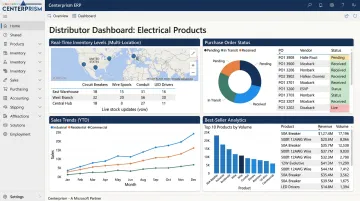
Centerprism's Full Spectrum ERP is built on Microsoft Dynamics GP and covers these requirements directly. PrismView delivers real-time visibility into sales trends, best sellers, and profit margins without a separate BI database or data exports. Because it connects to an existing GP database with no added configuration, most implementations are live the same day with no operational disruption.
How to Evaluate Your Options
Once you know what the system should do, match those capabilities to your specific operation. A few questions worth answering before you commit:
- How many SKUs are you managing, and are they growing?
- How many locations or branches need shared inventory visibility?
- What's your daily order volume, and where are the fulfillment bottlenecks?
- Can the system be configured without a six-month IT implementation project?
MDM reports that only 15% to 30% of distributors have adopted warehouse management systems, noting that speed and accuracy are difficult to deliver without one. The same holds for integrated ERP — every month on disconnected systems adds compounding cost in manual corrections, missed orders, and slow reporting.
Frequently Asked Questions
What is distribution inventory management?
Distribution inventory management is the process of purchasing, storing, tracking, and fulfilling products across a distributor's locations to meet customer demand. For electrical distributors, it covers everything from demand forecasting and procurement through receiving, replenishment, and order fulfillment.
What are the 5 steps of inventory management?
The five steps are demand planning, procurement, receiving and stock organization, real-time tracking with automated replenishment, and ongoing reporting and optimization. Each step builds on the previous one, forming a continuous cycle that compounds efficiency over time.
What are the 4 types of inventory management?
The four main types are just-in-time (JIT), ABC analysis-based management, bulk or safety stock management, and consignment inventory. For electrical distributors managing large, varied SKU catalogs, ABC analysis combined with safety stock for high-velocity A-items is the most practical approach for most operations.
What is the 80/20 rule in inventory management?
The 80/20 rule holds that roughly 80% of sales revenue comes from 20% of products. Electrical distributors apply it by classifying SKUs into A, B, and C tiers, directing the most capital, shelf space, and reorder attention toward the high-revenue A-items while setting tighter controls on low-velocity stock.
How do electrical distributors reduce stockouts without overstocking?
Calculated reorder points based on actual usage and supplier lead times—rather than arbitrary minimums—prevent both failure modes simultaneously. Cycle counting keeps inventory data accurate between physical counts, and real-time visibility ensures replenishment triggers activate on time, before shortages occur.