According to a 2025 PYMNTS/American Express study, 86% of businesses report that up to 30% of monthly invoiced sales are overdue—and invoice disputes alone consume 27% of AR team time. For distributors operating at volume, that's a significant drag on working capital.
Cloud-based distributor billing software addresses this directly. This guide covers what it is, which features actually matter for distribution workflows, how it compares to on-premise systems, and what to look for when evaluating options.
Key Takeaways
- Cloud billing software centralizes invoicing, AR, payments, and sales data in one real-time platform accessible from any device
- Distributor-specific billing tools handle customer pricing tiers, credit management, and commission tracking—generic invoicing apps don't
- Moving off spreadsheets or legacy desktop systems reduces billing errors and speeds up order-to-cash
- Real-time analytics eliminate the spreadsheet export cycle, giving leadership live visibility into margins and sales trends
- Purpose-built platforms can be installed and running the same day, with no months-long ERP rollout required
What Is Cloud-Based Distributor Billing Software?
Cloud-based billing software runs on remote servers, not local hardware. For distributors, that means invoicing, accounts receivable, customer payments, and sales data are all accessible from any internet-connected device — updated in real time across every user and location.
What Makes It Distributor-Specific
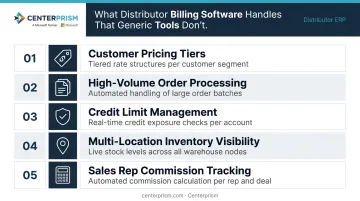
Generic invoicing tools—QuickBooks, FreshBooks, and similar apps—handle basic billing. They are not built for distribution. Distributor billing software handles:
- Customer-specific pricing tiers and negotiated price memorization
- High-volume order processing with automated invoice generation
- Credit limit management and collections workflow
- Multi-location inventory visibility tied to invoicing
- Sales rep commission tracking calculated automatically per invoice
How It Differs from Full ERP
A full ERP platform manages procurement, warehousing, manufacturing, and finance across the entire business. Distributor billing software focuses specifically on the revenue side—order entry, invoicing, collections, and sales analytics. It can function as a standalone tool or integrate within a broader ERP environment.
Platforms like Centerprism, built on Microsoft Dynamics GP, extend an existing ERP foundation with distribution-specific billing, AR, commissions, and real-time analytics—without requiring distributors to replace their entire system.
Who Benefits Most
- Industrial distributors managing complex customer pricing and field sales teams
- Consumer goods wholesalers running high transaction volumes with diverse customer accounts
- Rental supply companies handling recurring billing and flexible pricing structures
Key Features to Look for in Cloud-Based Distributor Billing Software
Distribution billing has specific demands that generic invoicing software wasn't built to handle—multi-tier pricing, rep commissions, AR collections, and real-time visibility across hundreds of customer accounts. Here's what to look for in a platform built for the job.
Automated Invoicing and Order-to-Cash Processing
Manual invoicing creates two problems: errors and delays. When billing staff manually enter pricing and apply discounts, mistakes happen—and disputes slow collections further.
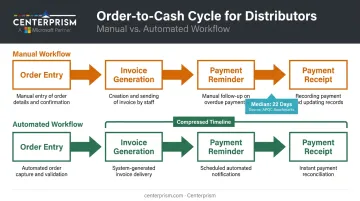
Automated invoicing generates accurate bills based on pre-configured pricing rules, customer-specific agreements, and discount schedules. Once those rules are set, every invoice reflects negotiated terms without manual lookup or re-entry.
The business impact is direct. APQC benchmarks across 3,452 companies put the median cycle time from invoice transmission to payment receipt at 22 days. Distributors with manual AR workflows sit at or above that median. Automating the order-to-cash cycle compresses that timeline, improving working capital without adding headcount.
Centerprism's Price Memorization module stores customer-specific and historical pricing for repeat transactions. On subsequent orders, the system automatically applies those rates—no manual lookups, no entry errors.
Real-Time Analytics and Sales Reporting
MDM research found that 80.4% of distributors still rely on spreadsheets for data analytics, while only 8.9% consider themselves analytics leaders. The core problem: spreadsheet exports are outdated the moment they're generated.
Billing software worth using gives distributors live dashboards they can access without IT involvement or manual exports. At minimum, the platform should surface:
- Sales trends by rep, customer, or product line
- Best-selling items by margin and volume
- Year-over-year comparisons without building the view manually
Centerprism's PrismView tool connects directly to the live Dynamics GP database—no separate BI database, no export required. Users can sort, filter, and group by customer, item, salesperson, or vendor in real time. The split-screen year-over-year comparison feature alone replaces what most distributors currently do in Excel.
Accounts Receivable and Collections Management
AR performance is where billing software pays for itself fastest. Key features to look for:
- Automated payment reminders triggered by invoice age
- Batch email invoicing for high-volume customer bases
- Collections workflow automation with custom status tracking and escalation templates
- Cash receipts dashboards that simplify payment application across varied invoice amounts
- Customer payment portals for self-service online payment
Centerprism's Collection Management System automates reminders, tracks all customer communications in one place, and supports escalation templates for overdue accounts. Its sliding commission depreciation feature—which reduces a rep's commission as their customers' invoices age past due—creates a built-in incentive for sales staff to support collections.
Integrated Credit Card Processing and Payment Application
Strong AR workflows only go so far if payment collection itself is fragmented. B2B check payments have dropped dramatically—from 81% in 2004 to 26% in 2025, according to Nacha. Distributors still processing payments manually and reconciling in a separate tool are adding friction at every step.
Integrated payment processing lets customers pay invoices directly through the platform, with cash automatically applied to open invoices in the same system. That eliminates reconciliation errors from mismatched payment records across disconnected systems.
Centerprism's Cash Receipts Dashboard handles this natively, with integrated credit card processing built in—no third-party payment system required for basic card acceptance.
Sales Management and Commission Tracking
Accurate commission tracking is harder than it looks. Manual spreadsheet calculations are a consistent source of rep disputes, and errors compound quickly across tiered structures or shared accounts. Billing software should connect directly to commission logic so payouts are calculated from actual billing data—not re-entered downstream.
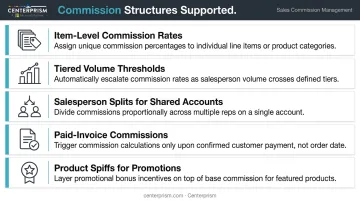
Centerprism's Advanced Sales Commissions Module supports:
- Commission rates set at the item level
- Tiered rates based on volume thresholds
- Salesperson splits for shared accounts
- Paid-invoice commissions (commissions recognized only when invoices are collected)
- Product spiffs for targeted promotions
Custom plans can be configured per salesperson, meaning no two reps need to be on identical structures.
Cloud-Based vs. On-Premise Billing Software: A Distributor's Perspective
| Factor | Cloud-Based | On-Premise |
|---|---|---|
| Upfront cost | Subscription-based, lower initial spend | Hardware + licensing investment required |
| Time to value | Weeks to days (or same day for purpose-built tools) | Months for configuration and deployment |
| IT maintenance | Vendor-managed updates | Internal IT or consulting fees |
| Scalability | Add users/locations without infrastructure changes | Hardware purchases required for growth |
| Accessibility | Any device, any location | Typically office-bound |
Panorama Consulting's 2026 ERP Report found the median ERP project takes 9 months to complete, with nearly 25% of organizations running over schedule. For distributors, that timeline translates directly into delayed billing, manual workarounds, and deferred revenue. Purpose-built cloud solutions are built to skip that runway entirely.
Signs Your Current System Is a Bottleneck
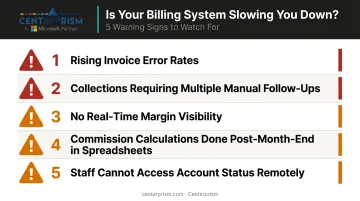
On-premise or spreadsheet-based billing has likely become a problem if you're experiencing:
- Rising invoice error rates or billing disputes
- Collections that take multiple manual follow-ups per invoice
- No real-time visibility into margins without pulling a report
- Commission calculations done in spreadsheets after month-end close
- Staff unable to access customer account status outside the office
If several of these sound familiar, the infrastructure overhead likely isn't worth it. For most small-to-mid-sized distributors, the case for local control has weakened — today's cloud platforms handle the complex workflows that once required custom on-premise builds.
How to Choose the Right Cloud-Based Distributor Billing Software
Evaluation Criteria
Prioritize these factors when assessing platforms:
- Distributor-specific functionality — customer pricing tiers, commission management, AR automation, credit management
- Integration with existing systems — accounting (QuickBooks, Sage), ERP, or inventory platforms; 55% of wholesale distributors already have core systems that aren't connected to each other
- Ease of use for non-technical staff — billing, collections, and sales teams should be able to operate the system without IT involvement
- Vendor support quality — implementation support, training, and ongoing responsiveness
Implementation Speed Matters More Than Most Buyers Realize
Once you've mapped your evaluation criteria, implementation timeline becomes the factor most distributors regret not scrutinizing sooner.
Many distributors underestimate how much a long implementation disrupts operations. Enterprise platforms require months of configuration before going live — billing cycles get delayed, staff juggle two systems, and productivity drops before it improves.
Centerprism connects directly to an existing Dynamics GP database without building or configuring a separate database, so distributors are operational the day the system is installed. No 9-month ERP project. No lost billing cycles while waiting for go-live.
Total Cost of Ownership
Implementation speed affects cost too — the longer the rollout, the more internal hours your team absorbs. That's why total cost of ownership deserves its own line in any vendor comparison.
Monthly subscription cost is only part of the picture. Ask vendors directly about:
- Implementation fees (included or extra?)
- Data migration support
- Training resources
- Integration costs for connecting to existing tools
- What changes at renewal
A lower monthly fee with significant add-on costs often exceeds a slightly higher all-in subscription.
Common Challenges When Transitioning to Cloud Billing
Data Migration and Staff Adoption
Two challenges consistently surface during transitions:
Data migration requires moving customer records, pricing rules, and open invoices from a legacy system without errors. Phased migration — starting with active customers and open AR, then migrating historical data — reduces risk. Confirm before purchasing whether the vendor provides migration support or whether that's a separate engagement.
Staff adoption shapes how quickly your team starts generating value. Billing, collections, and sales teams need to learn new workflows, and rolling out core billing functions before enabling advanced features like commission tracking or the customer portal reduces overwhelm and speeds up time-to-productivity.
Organizational resistance is the leading cause of ERP project delays, per Panorama's research: less than 25% of organizations invest meaningfully in change management. Building in training time from the start is not optional.
Internet Dependency
Infrastructure is the other side of the readiness equation. Cloud software requires a reliable internet connection to function in real time, and for most US-based distribution businesses on standard business internet, this rarely causes issues. That said, it's worth a quick audit before you commit:
- Main office: Standard business internet handles cloud billing without issues in the vast majority of cases
- Warehouse and branch locations: Spotty connectivity can disrupt real-time workflows — verify uptime reliability at those specific sites before signing a contract
Frequently Asked Questions
What is cloud-based billing?
Cloud-based billing is software hosted on remote servers that lets businesses create invoices, manage payments, and track accounts receivable from any internet-connected device. Data updates automatically in real time rather than being stored on local hardware, so every user sees current information regardless of location.
What software do distributors use?
Distributors typically use a combination of billing and ERP tools—ranging from full ERP platforms like NetSuite, Dynamics 365, or Epicor Prophet 21 to purpose-built systems. Centerprism is one example: designed specifically for industrial distributors, wholesalers, and rental supply companies running on Microsoft Dynamics GP.
How is cloud-based distributor billing software different from generic invoicing tools?
Distributor billing software includes features like customer-specific pricing tiers, credit limit management, sales commission tracking, and automated collections workflows. Generic invoicing tools like QuickBooks or FreshBooks don't natively support these distribution workflows at the complexity and volume distributors require.
How long does it take to implement cloud-based billing software?
Enterprise ERP projects typically take nine months or longer. Purpose-built distributor billing platforms can often be operational within days—Centerprism, for example, is designed for same-day implementation due to its direct database connection architecture.
Can cloud billing software integrate with my existing accounting or inventory system?
Most cloud billing platforms offer integrations with common accounting systems like QuickBooks and Sage. Centerprism is built on Microsoft Dynamics GP, making it a natural fit for distributors already on that platform. Confirm specific integration compatibility—and any associated costs—before purchasing.
Is cloud-based billing software secure enough for sensitive financial data?
Reputable cloud billing vendors use encrypted data storage, role-based access controls, and automated backups. Look for vendors that comply with PCI DSS for payment data and maintain SOC 2 certification for broader data security controls.