The result is predictable: sales reps quote products that aren't in stock, miss follow-ups on aging accounts, and spend hours reconciling commission spreadsheets instead of closing deals. According to Panorama Consulting's 2024 ERP Report, 46% of organizations cite better data visibility as a primary reason for ERP adoption — a telling sign of how costly siloed systems have become.
This guide explains exactly how ERP for sales works, what it automates, where it delivers the most impact for distributors and wholesalers, and what to look for when choosing one.
Key Takeaways
- ERP for sales unifies orders, inventory, pricing, receivables, and reporting into one real-time platform
- Routine tasks like order entry, invoicing, and payment reminders are automated — freeing reps to sell
- Live dashboards give managers instant visibility into trends, margins, and rep performance
- Distributors and wholesalers get native tools for commission tracking, credit management, and customer-specific pricing
- Strong ERP picks balance integration depth with fast adoption — not just feature count
What Is ERP for Sales?
ERP for sales is a business management platform that extends traditional ERP capabilities — finance, inventory, supply chain — directly into the sales process. Orders, customer data, pricing, and reporting all live in one connected system and update in real time.
The term gets misused often, so the distinction matters:
| What It Handles | What It Doesn't | |
|---|---|---|
| CRM | Contacts, pipeline stages, activity logs | Back-office operations, live inventory, margin data |
| Order Management | Transactions | Purchasing, receivables, commissions, analytics |
| ERP for Sales | All of the above, connected | Nothing siloed — every sale carries full operational context |
A rep building a quote in an ERP works from live inventory levels and actual margin data — not a price list exported last Tuesday. That real-time connection is what separates ERP for sales from both tools.
That distinction becomes critical as distributors and wholesalers scale. The complexity grows fast:
Why It Becomes Necessary
- Hundreds or thousands of SKUs across multiple locations
- Customer-specific pricing contracts that vary by account
- Commission plans that differ by rep, product, and customer tier
- Credit terms extended across dozens of active accounts simultaneously
Spreadsheets and disconnected tools can't manage that volume reliably. According to NAW, U.S. wholesale distribution is an $8.2 trillion industry — and at that scale, manual sales management isn't just inefficient, it's a revenue risk.
How ERP Automates the Sales Cycle
ERP doesn't just support the sales process — it structures it as a defined automated workflow. From the first inquiry through cash collection, each stage triggers the next without manual handoffs.
Lead and Quote Initiation
When a sales inquiry comes in, an ERP immediately surfaces the customer's credit status, purchase history, open orders, and product availability before a rep even starts building a quote. No more bouncing between three systems to find out whether a customer is on credit hold or whether a product ships in two days or two weeks.
Rule-based product configurators take this further for distributors with complex or variable catalogs. Instead of building custom quotes manually, reps walk through a step-by-step Q&A that produces accurate, fully configured pricing with approved discount tiers already applied. This eliminates the pricing guesswork that costs margin when reps negotiate on the fly.
Order Processing and Fulfillment
Once a quote is approved, ERP takes over:
- Converts the quote to a sales order automatically
- Reserves inventory against the order
- Triggers fulfillment workflows downstream
- Generates and sends the invoice
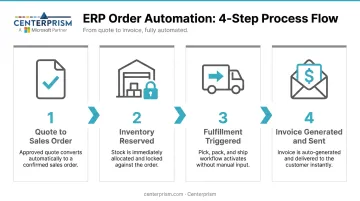
No re-keying data across systems. No email chains to confirm availability. Automated order status updates and shipment notifications keep customers informed without service team intervention — reducing inbound "where's my order" calls that consume AR and customer service time.
Real-Time Inventory and Pricing Sync
For distributors managing large, fast-moving catalogs, committing to stock that doesn't exist carries a real cost: returned orders, emergency sourcing, damaged customer relationships.
ERP keeps sales data synchronized with live inventory, so reps never quote products that are out of stock or on backorder. Customer-specific pricing rules, contract rates, and volume discounts are enforced automatically at the point of sale — protecting margins without requiring manual review on every transaction.
Receivables, Commissions, and Reporting
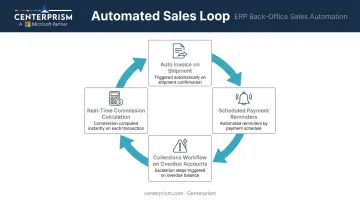
ERP closes the sales loop on the back end:
- Invoices are sent automatically upon shipment
- Payment reminders trigger on a defined schedule before and after due dates
- Collections workflows activate on overdue accounts with tiered escalation
- Commission calculations run automatically based on configurable rules — by product, margin, volume, or customer tier
Monthly commission reconciliation — which often means multiple spreadsheets and hours of manual cross-referencing — drops to near zero effort when the system calculates and tracks payouts in real time. For most distributors, that alone is a meaningful operational win.
Key Benefits of ERP for Sales Teams
Real-Time Visibility Replaces Reporting Lag
The most immediate benefit sales managers notice is visibility. Live dashboards surface pipeline status, order volume, best-selling products, and profit margins without exporting data to Excel or waiting on another department's weekly report.
Centerprism's PrismView analytics tool exemplifies this: it connects directly to the live Dynamics GP database with no separate database required, meaning data is never stale. The Sales Activity Dashboard allows managers to sort and filter by salesperson, customer, product, or vendor — with a split-screen view for year-over-year comparisons built in.
Forecasting Accuracy Improves Measurably
ERP consolidates the historical order patterns, seasonal trends, and pipeline data that forecasting depends on. Without a unified data foundation, those inputs exist in silos — and forecasts built on fragmented data are rarely reliable.
In a 2026 Forrester TEI study of Dynamics 365 ERP for midmarket organizations, one customer reported forecast accuracy improving from the low 80% range to the low 90% range after ERP data consolidation. A separate Forrester enterprise TEI found 62% of respondents agreed ERP improved demand forecast accuracy and reduced inventory waste.
Sales Rep Performance Becomes Trackable
With consolidated ERP data, managers can monitor each rep without waiting on self-reported updates. Trackable metrics include:
- Sales trends by rep, region, or account
- Margin performance across product lines
- Account rankings and revenue concentration
- Commission outcomes tied to actual collections
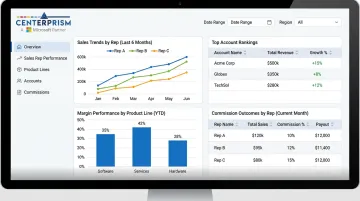
That visibility sharpens coaching conversations and speeds up resource allocation decisions.
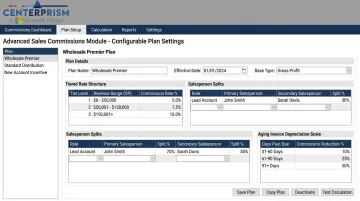
Centerprism's commissions module adds accountability on the collections side: a sliding depreciation scale automatically adjusts rep commission based on the aging of past-due invoices assigned to them, linking compensation directly to account health.
Duplicate Data Entry Disappears
When sales, inventory, and accounting share one system, the hours previously spent reconciling records across platforms get redirected to selling. Forrester's 2026 enterprise ERP TEI reported 35% acceleration in sales and order management — a concrete indicator of what operational unification actually delivers.
Where ERP Delivers the Most Impact: Distributors and Wholesalers
Distribution and wholesale businesses operate with a specific type of sales complexity that generic tools handle poorly:
- Large product catalogs with customer-specific pricing contracts
- High order volumes across multi-location inventory
- Credit terms extended to dozens or hundreds of customers simultaneously
- Commission plans that vary by rep, product line, and account
The Receivables Problem
According to Atradius's 2025 B2B Payment Practices report, 43% of U.S. credit-based B2B sales were overdue, with average payment terms running 46 days. For distributors extending credit across hundreds of accounts, that's an AR team that's perpetually overwhelmed without automation.
ERP automates the full payment cycle: invoices go out immediately upon shipment, reminders trigger on schedule, and overdue accounts enter collections workflows automatically. Centerprism's platform adds a self-service customer payment portal and integrated credit card processing, cutting the friction between invoice and payment.
Commission Management at Scale
Commission management is a persistent pain point in wholesale distribution, where plans vary by rep, product line, and customer account. Manual spreadsheet reconciliation at month-end creates errors, disputes, and rep distrust in their own payouts.
Centerprism's Advanced Sales Commissions Module handles this natively with configurable plans per salesperson: it supports tiered rates, salesperson splits, paid invoice commissions, product spiffs, and the sliding depreciation scale tied to aging invoices. Managers configure plans once; the system calculates and tracks from there.
PrismView analytics surfaces this data in real time — profit margins, top performers, emerging trends — directly from the dashboard. No export required, no lag between action and insight.
Rental Supply Companies
Rental supply businesses face a quoting problem unique to their model: reps need to know what's actually available before committing to a customer. ERP ties equipment availability, return schedules, and utilization rates directly into the sales workflow. Reps quote from live asset data — not a guess from a disconnected system — which reduces over-promising and costly booking conflicts.
How to Choose the Right ERP for Sales Management
Integration Depth and Real-Time Data Access
The most important criterion is whether sales, inventory, pricing, and financials connect in one system — with no nightly sync, no separate database, and no lag between a transaction and its visibility in reporting.
This matters practically: if a rep's pricing data is 12 hours old, they can quote a margin that no longer exists. If inventory is updated overnight, they can commit to stock that's already gone.
Centerprism addresses this with a real-time database connection and same-day plug-and-play installation that requires no separate database infrastructure. For distributors who've avoided traditional ERP because of lengthy deployments, that's a practical entry point.
CRM and Commission Functionality
Look for:
- A full-spectrum CRM built into the ERP (not a third-party app synchronized on a schedule)
- Customer interaction tracking, follow-up automation, and order history accessible in the same view
- A commissions engine that supports flexible plan structures — by product, margin, volume, and rep — without manual workarounds
When customer interactions, order history, and payment behavior live in separate systems, reps are always working from incomplete context. A CRM built into the ERP eliminates that problem at the source.
Analytics Without Extra Infrastructure
Ask vendors directly: does the analytics tool require a separate database license, or does it operate within the ERP environment?
Most standalone BI tools introduce more overhead than value:
- Data warehouses and ETL pipelines add cost before you see a single report
- Scheduled syncs create latency that makes the data stale by the time it's used
- Maintenance falls on IT, not the sales team
The goal is a reporting tool that surfaces sales trends, margin performance, and rep productivity without exports, additional software, or an ongoing IT project behind it.
Frequently Asked Questions
What does ERP stand for in sales management?
ERP stands for Enterprise Resource Planning. In a sales context, it refers to a unified software system that connects sales order management, inventory, customer data, pricing, and financial reporting in one platform — replacing disconnected tools with a single source of real-time operational data.
What are the 4 pillars of ERP?
ERP systems commonly rest on four foundational elements: a single integrated database, modular design (finance, sales, inventory, HR, etc.), automated workflows across departments, and real-time reporting. For sales teams, these pillars mean accurate data flows through every step of the sales cycle without manual handoffs between systems.
How is ERP different from a standalone CRM for sales?
CRM focuses on managing customer relationships and pipeline activity. ERP extends into back-office operations — connecting sales to live inventory, actual pricing margins, receivables, and fulfillment. The difference matters when a rep makes a commitment: ERP ensures the business can actually keep it.
Can ERP automate sales commission calculations?
Yes. Sales-focused ERP systems with built-in commission modules calculate payouts based on configurable rules — by product, margin, volume, or customer tier — and track results in real time. That replaces the month-end spreadsheet reconciliation that routinely causes disputes between reps and finance.
How does ERP help distributors and wholesalers specifically?
For distributors and wholesalers, ERP handles high-volume order processing, customer-specific pricing contracts, multi-location inventory visibility, automated receivables, and commission tracking at scale. Generic CRM or standalone order management tools weren't built for that level of sales complexity.
How quickly can a business implement an ERP for sales?
Implementation timelines vary. Traditional ERP deployments typically take 3 to 9 months for small and mid-sized businesses. Centerprism, built specifically for distributors, can be configured and operational in a single day — making it a practical option for businesses that can't afford a lengthy rollout.