"Automation" gets mentioned constantly, but the conversation rarely gets specific. What does it actually return? Not in abstract efficiency terms, but in dollars recovered from errors, hours freed from data entry, and orders processed while competitors are still waiting for their first CSR to clock in.
This article breaks down the measurable ROI of automating order entry across three operational dimensions — and covers what the math looks like when that investment keeps getting deferred.
Key Takeaways
- Manual order entry errors cascade into re-shipments, credit memos, and customer disputes that cost far more than the original mistake
- APQC benchmarks show the median time to create a single sales order manually is 1.5 hours across 521 companies
- Faster order processing is a competitive differentiator — after-hours orders captured automatically ship sooner than those waiting for morning CSR entry
- CSR time freed from data entry can shift toward upselling, quote follow-up, and account management
- Automation absorbs order volume growth without requiring proportional headcount increases
What Is Order Entry Automation?
Order entry automation is the use of technology — OCR, AI parsing, EDI, and ERP integration — to capture, validate, and process customer orders without a human manually keying in each line item.
In a distribution context, that covers every channel currently requiring a CSR to re-enter data:
- Emailed POs (PDFs, Word docs, spreadsheet attachments)
- Faxed purchase orders
- Customer portal submissions
- EDI transactions from large buyers
- Sales rep-submitted orders from the field
The measure of success is purely business outcomes: fewer errors, faster fulfillment, lower operating cost, and the ability to grow order volume without adding headcount at the same rate.
Key ROI Advantages of Automating Order Entry for Distributors
The three advantages below are grounded in operational outcomes distributors can track and quantify. Each one ties directly to a cost center or revenue lever that shows up on a distributor's P&L or operational KPIs — not theoretical efficiency claims.
Eliminating Order Entry Errors Reduces Direct Operational Costs
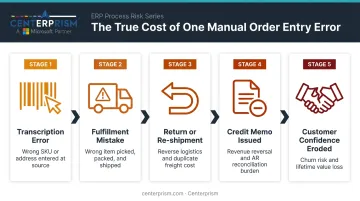
Manual entry introduces transcription errors: wrong SKUs, incorrect quantities, mismatched ship-to addresses. Each one triggers a chain of downstream consequences — re-shipments, returns, credit memos, customer service escalations. The original error is just the starting cost.
Automation addresses this at the source. OCR and AI parsing extract order data and validate it against the ERP's customer and product master before any order record is created. Mismatches get flagged before they become fulfillment mistakes, not after the truck has already left.
Why this matters for distributor margins:
According to APQC benchmarking data, 15% of manual sales order interventions are caused by incorrect customer master data alone — and that's just one error category. Every correction carries a compounding cost: the direct expense of fixing the mistake plus the erosion of customer confidence that builds with each repeat incident.
For distributors operating on thinner margins, the math is unforgiving. A single misdirected shipment or disputed invoice can erase the profit from several clean orders — especially when credit memos, restocking, and customer service time are factored in.
This advantage matters most for:
- High SKU count operations where product master mismatches are common
- Businesses with multiple ship-to locations per customer account
- Distributors processing large multi-line POs where one error in a 50-line order triggers a full review
KPIs directly impacted: order accuracy rate, cost-per-order, return/rework rate, customer dispute volume, credit memo frequency
Faster Order Processing Protects Revenue and Strengthens Customer Retention
Speed-to-fulfillment is a direct competitive differentiator for distributors. When an overnight order is captured and entered automatically before the morning shift begins, it ships hours earlier than a competitor whose CSR won't process it until 9 AM.
A contractor submits an urgent order at 7 PM. Without automation, it ships the following afternoon. With automation, it ships that morning. In industries where unplanned downtime carries a real dollar cost, that half-day difference often determines which distributor earns the next order.
The retention risk is documented:
McKinsey's 2024 B2B Pulse research found that more than half of B2B buyers are likely to switch suppliers when they don't have a smooth cross-channel experience — and that 54% of those who switched cited poor-quality digital customer experiences as the reason. Order processing speed and accuracy are core components of that experience.
Earlier Accenture research reinforced this: 80% of frequent B2B buyers said they had switched suppliers at least once in a 24-month period because the supplier couldn't align services with their expectations.
What this costs in practice:
Even losing a small percentage of time-sensitive orders annually to a faster competitor compounds significantly over a year — particularly for high-value accounts where competitors are already actively courting the same buyer.
This advantage matters most for:
- Distributors serving contractors, MRO operations, or manufacturing facilities with urgent, unplanned needs
- High-value accounts where the relationship is still being established
- Any operation competing against distributors who have already automated
KPIs directly impacted: order-to-ship cycle time, same-day fulfillment rate, customer retention rate, reorder frequency
CSR Time Reallocation Enables Scalable Growth Without Proportional Headcount Increases
Manual order entry consumes a substantial portion of every CSR's working day. APQC's benchmarking data puts the median time to create a single sales order at 1.5 hours across 521 companies. Conexiom's industry research suggests some CSRs spend up to 4 hours per day on manual order typing — time that isn't being spent on customers.
Once 70–90% of routine orders process automatically, that dynamic shifts. CSRs move from data entry operators to revenue contributors — handling technical questions, following up on open quotes, identifying upsell opportunities, and giving high-value accounts the attention they actually require.
The scalability math:
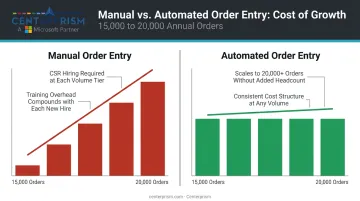
A distributor growing from 15,000 to 20,000 annual orders no longer needs to hire an additional CSR if 80% of those orders process automatically. The same team handles significantly more volume. For distributors with seasonal spikes, this is especially valuable — headcount flexibility without the recruitment and training overhead.
What redirected CSR time looks like in practice:
Rexel Canada, an electrical distributor, reported that 70% of sales orders were manually entered before automation. After deploying sales order automation for 600 customers, their inside sales team reclaimed thousands of hours previously spent on data entry — hours they redirected toward customer-facing activity.
When CSRs have real-time visibility into which accounts are growing, which products are trending, and where margins are strongest, they can act on that intelligence immediately. Platforms like Centerprism, with its PrismView real-time analytics, give redirected CSRs instant access to sales trends, best sellers, and profit margin data directly from their ERP. No separate database or spreadsheet exports required.
This advantage matters most for:
- Mid-volume distributors under growth pressure who are weighing a headcount hire
- Operations with seasonal order spikes that strain current CSR capacity
- Businesses where CSRs are reactive all day rather than proactive
KPIs directly impacted: revenue per CSR, upsell rate, order volume per headcount, average order value, CSR capacity utilization
What Happens When Order Entry Automation Is Missing
Staying manual has a compounding cost — and it builds slowly enough that most distributors don't see the damage until it's significant. Errors accumulate. Fulfillment slows. CSRs spend their day correcting yesterday's mistakes while automated competitors absorb the same order volume without breaking stride.
The specific consequences for distributors:
- Order disputes erode customer relationships one error at a time, often before anyone flags a pattern
- Returns, re-ships, and credit memos eat into margins across thousands of orders annually — rarely appearing as a single line item, but always adding up
- Every jump in order volume requires a matching increase in headcount just to maintain current processing speed
- CSRs spending hours each day correcting entry mistakes see morale drop, and turnover follows
The competitive displacement risk is real:
Distribution Strategy Group's 2026 research found that 55% of North American wholesale distributors have invested in core technology systems but haven't integrated them. Meanwhile, 93% are exploring AI, but only 23% have reached the scaling or integration stage. The barriers are mostly practical: 57% cite skills gaps, 52% point to poor data quality, and 51% report unclear ROI expectations.
Distributors who automate and integrate first build a speed and cost advantage that manual competitors can't close through effort alone — because the gap widens with every quarter of additional order volume.
How to Get the Most Value from Order Entry Automation
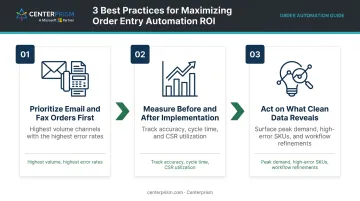
Automation delivers its strongest return when applied systematically, not as a patchwork fix across disconnected channels. Three practices separate distributors who capture lasting ROI from those who see diminishing returns after the initial rollout:
Prioritize email and fax orders first. These channels carry the highest volume and the highest error rates for most distributors. Automating them before lower-volume sources produces the fastest measurable return.
Measure before and after implementation. Track order accuracy rates, cycle times, CSR capacity utilization, and error correction costs on both sides of the rollout. Systems with built-in analytics — like Centerprism's PrismView — surface these metrics on demand, removing the need for separate reporting tools and making the internal ROI case straightforward.
Act on what clean data reveals. Automated order capture surfaces patterns that manual processes hide: peak demand periods, high-error SKUs, customers who default to phone orders instead of self-service. Distributors who use these insights to refine their workflows build on that ROI over time, rather than treating automation as a one-time install.
Conclusion
The ROI of order entry automation surfaces in three concrete places:
- Reduced error costs from fewer manual mistakes and rework
- Faster fulfillment that retains revenue and customer relationships
- CSR capacity freed for growth without adding headcount
None of these are speculative — they're measurable outcomes tracked against standard operational KPIs.
The cost dynamic also favors action over delay. As order volume scales, the per-order cost of manual entry scales with it. The cost of automation stays relatively flat. That gap doesn't close on its own — it widens every quarter automation is deferred.
Distributors who treat automation as a living system — tracking error rates, refining workflows, and expanding coverage as volume grows — capture compounding returns over time. The ones who get there first lock in a structural cost and speed advantage. The math only gets harder to ignore.
Frequently Asked Questions
How can order entry automation reduce manual data entry for wholesale distributors?
Automation uses OCR, AI parsing, and ERP integration to capture orders from emails, PDFs, portals, and EDI feeds, converting unstructured inputs into ERP records without a CSR retyping each line item. This eliminates repetitive data entry, leaving CSRs to handle exceptions and customer interactions.
What is the 80/20 rule for automation?
In distribution, roughly 80% of order volume — email, portal, EDI, and repeat orders — is structured enough to process automatically. The remaining 20% (complex, ambiguous, or exception orders) routes to a CSR for review. This keeps human attention focused where it adds the most value.
What is the typical ROI timeline for order entry automation?
Payback periods vary by order volume and channels automated. Distributors processing higher daily volumes commonly see payback within 12–18 months, with measurable labor and error-cost savings appearing in the first year of deployment.
How does order entry automation affect customer satisfaction?
Automated processing reduces the two most common causes of B2B customer complaints: fulfillment delays and order errors. After-hours order capture means faster confirmations and earlier shipments, which improves the customer experience and supports retention.
Can small and mid-sized distributors afford order entry automation?
Modern ERP platforms offer built-in order automation without requiring separate tools or extended implementations. For distributors processing even a few thousand orders annually, the ongoing cost of manual labor, error correction, and lost orders typically exceeds the investment in automation.
How does automated order entry integrate with a distributor's existing ERP system?
Most modern distribution ERPs support native integration with email order parsing, EDI trading partners, B2B portals, and marketplace channels — pulling orders directly into the sales order module, updating inventory, and triggering fulfillment automatically.