The stakes are real. According to ECIA and TrustedParts data, the top 50 Americas authorized electronics distributors grew from $28.8B to $30.9B in revenue between 2024 and 2025 — a 7.1% rebound after a painful two-year downturn. In that kind of market, the right inventory software isn't a back-office convenience. It's a competitive weapon.
This guide covers the top five inventory management platforms built for electronics distribution, the must-have features to evaluate, and a framework for choosing the right fit for your operation.
Key Takeaways
- Electronics distributors need software built for high-SKU environments, multi-location tracking, and procurement integration — not retail tools retrofitted for distribution
- Serial/lot tracking, automated reordering, and component substitution support are non-negotiable for electronics-specific workflows
- The five platforms here range from same-day ERP deployment to enterprise-grade cloud systems; the right fit depends on your size and complexity
- Spreadsheets and disconnected tools lead to stockouts, overstocking, and missed revenue opportunities
- Centerprism offers same-day implementation with real-time PrismView analytics built directly into its ERP for distributors
Inventory Management Software in Electronics Distribution
Inventory management software in electronics distribution does more than count boxes. The real work involves component lifecycle management, supplier variability, and thousands of SKUs across multiple sales channels — complexity that generic tools weren't built to handle.
Capable platforms for this space typically cover:
- Stock movement tracking across multiple warehouses
- Automated procurement triggers based on reorder thresholds
- Customer order management across sales channels
- Real-time visibility into component availability and lead times
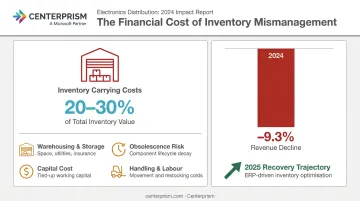
The financial pressure is significant. Inventory carrying costs typically run 20% to 30% of total inventory value, meaning every dollar of excess stock or mismanaged replenishment has a direct impact on margins. For electronics distributors already navigating a market that saw 9.3% revenue declines in 2024 before its 2025 recovery, those costs compound quickly.
That context shaped how the platforms below were evaluated. Each was selected for distribution-specific functionality, traceability capabilities, and verified track records with distributors and wholesalers — not general popularity or brand recognition.
Top 5 Inventory Management Software for Electronics Distributors
Each platform below was evaluated on distribution-specific functionality, multi-location capability, integration depth, and fit for electronics distribution's operational demands — from serial number traceability to real-time inventory visibility. The list spans small-business tools to enterprise ERPs, so the right choice depends on your team size, existing tech stack, and growth trajectory.
Centerprism – Full Spectrum ERP
Centerprism is a full-spectrum ERP built on Microsoft Dynamics GP, designed specifically for distributors and wholesalers in the US. Its same-day plug-and-play implementation — made possible by a no-separate-database architecture that connects directly to the live GP database — makes it an unusually fast-to-deploy option for small to mid-size electronics distributors who can't afford months of setup time.
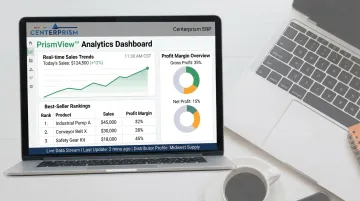
What sets Centerprism apart is the combination of operational and sales tools in a single platform. Its proprietary PrismView™ analytics tool delivers real-time sales trends, best-seller rankings, and profit margin analysis without spreadsheet exports — the data is always live. The integrated CRM with automated receivables and collections management, a rule-based product configurator for custom or configurable electronic components, and a customizable sales commissions module round out a platform that covers the full distribution workflow.
| Attribute | Details |
|---|---|
| Key Features | Real-time inventory visibility via PrismView™; integrated CRM and receivables automation; same-day plug-and-play installation; rule-based product configurator; customizable sales commissions; integrated credit card processing |
| Pricing / Deployment | Contact Centerprism for pricing; same-day implementation; no additional database required; US support at 1-800-814-6631 |
| Best For | Industrial and consumer electronics distributors and wholesalers seeking a fast-to-deploy, all-in-one ERP with built-in sales management and real-time analytics |
NetSuite ERP
Oracle's NetSuite is the enterprise-grade cloud ERP of choice for large and fast-growing distributors who need end-to-end supply chain visibility, multi-entity management, and advanced financial controls. With over 37,000 customers across more than 200 countries, it has the scale and partner network to support complex, multi-entity operations.
For electronics distributors, its strengths include demand planning with AI-powered forecasting, multi-location inventory management, native B2B commerce integration via SuiteCommerce, and extensive customization options through Oracle's partner network. G2 data puts the average implementation timeline at six months, and costs scale with complexity — factors that may limit its appeal for smaller operations.
| Attribute | Details |
|---|---|
| Key Features | Multi-location inventory tracking; demand planning and forecasting; multi-entity/multi-currency support; integrated order management and financials; SuiteCommerce for B2B ordering |
| Pricing / Deployment | Custom pricing; implementation-led deployment; Free Product Tour available via Oracle's website |
| Best For | Large or enterprise-scale electronics distributors managing multiple subsidiaries, regions, or high-volume supply chain operations |
Fishbowl
Fishbowl is the go-to inventory and warehouse management platform for small-to-mid-size distributors who want stronger warehouse control without abandoning QuickBooks. Fishbowl positions itself as the #1 inventory platform for QuickBooks and Xero users, and that integration remains its clearest competitive advantage.
For electronics distributors, it delivers barcode scanning for fast stock movements, serial and lot number tracking for warranty and compliance management, and automated purchase order generation from configurable reorder thresholds. Multi-location warehouse support is included. Its interface is functional but dated, and reporting customization is limited compared to full ERP alternatives.
| Attribute | Details |
|---|---|
| Key Features | Barcode scanning and mobile warehouse access; serial/lot number tracking; automated reorder and PO generation; deep QuickBooks and Xero integration; multi-location inventory management |
| Pricing / Deployment | Starts at $229/month (Essentials, billed annually); verify current pricing on Fishbowl's website; cloud deployment available |
| Best For | Small to mid-size electronics distributors already using QuickBooks who need stronger warehouse control and traceability without a full ERP investment |
Cin7 Core
Cin7 Core is a cloud-based inventory platform built for growing distributors managing stock across multiple warehouse locations. It combines strong inventory automation with a wide integration ecosystem — over 700 integrations — spanning accounting, e-commerce, and marketplace platforms.
Electronics distributors will find value in its configurable reorder point automation by SKU and location, batch and serial number tracking for component traceability, and a B2B self-service portal for 24/7 wholesale ordering. Native connections to QuickBooks, Xero, Shopify, and Amazon keep data flowing across systems without manual effort. That said, simpler single-location operations may find the feature depth more than they need.
| Attribute | Details |
|---|---|
| Key Features | Multi-warehouse real-time inventory tracking; automated PO generation at configurable reorder points; batch, lot, and serial number tracking; B2B portal for wholesale ordering; 700+ integrations |
| Pricing / Deployment | Starts at $349/month; verify current pricing on Cin7's website; cloud-based deployment |
| Best For | Growing electronics distributors managing inventory across multiple locations who need strong automation and broad accounting/e-commerce integration |
Acumatica Distribution Edition
Acumatica is a flexible cloud ERP with a dedicated Distribution Edition, distinguished by its consumption-based pricing model — unlimited users, with costs tied to transactions and resources rather than seat count. That structure makes it financially predictable as distributor teams grow, which is why it positions itself as a mid-market alternative to heavy enterprise ERPs.
Its open API architecture enables integration with specialized electronics procurement or CRM tools, and its role-based dashboards with AI-driven analytics give operational teams actionable visibility without custom reporting work. Automated replenishment, barcode scanning, and multi-location transfers are all included. Implementation typically requires a VAR partner and carries higher upfront setup effort.
| Attribute | Details |
|---|---|
| Key Features | Real-time multi-warehouse inventory visibility; automated replenishment and barcode scanning; open API for CRM and e-commerce integrations; role-based analytics dashboards; consumption-based unlimited-user pricing |
| Pricing / Deployment | Custom consumption-based pricing; verify on Acumatica's website; partner-led implementation required |
| Best For | Mid-market electronics distributors needing a scalable cloud ERP with flexible integrations and predictable per-transaction pricing |
Must-Have Features for Electronics Distribution Inventory Software
Electronics distribution has requirements that generic inventory tools simply weren't built for. These five features are the ones that actually move the needle.
Real-Time, Multi-Location Inventory Visibility
Electronics distributors managing multiple warehouses or branches need live stock data at every location rather than batch-updated reports from last night's sync. Without it, fulfillment errors multiply, duplicate orders get placed, and demand spikes triggered by supply chain disruptions go unaddressed until it's too late.
Real-time visibility means sales teams can quote accurately, purchasing can respond immediately, and management can spot imbalances before they become customer problems.
Serial Number, Lot, and Batch Tracking
Electronics-specific compliance and warranty management requires the ability to trace individual components or product batches from receipt through sale. This isn't optional when:
- A customer files a warranty claim and needs documentation of the original component lot
- A product recall requires identifying every customer who received an affected batch
- A regulatory audit demands supply chain traceability under standards like IPC-1782
SAE AS6081 addresses counterfeit electronic parts avoidance for distributors specifically — and traceability is a core requirement within that framework.
Automated Reordering with Component Substitution Support
Electronics distributors face procurement challenges that general distributors don't: component obsolescence cycles, long supplier lead times, and the risk of being caught holding end-of-life parts. Good inventory software addresses this with:
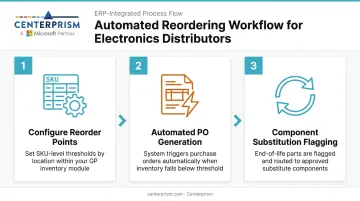
- Configurable reorder points by SKU and by location
- Automated PO generation when thresholds are hit
- Flagging or suggesting approved substitute part numbers when a primary component goes end-of-life
JEDEC JESD48C requires suppliers to provide at least six months from notice date for final orders — distributors who aren't tracking component lifecycles in their system often miss that window altogether.
Integrated Sales Management and CRM
For electronics distributors, the gap between inventory data and sales activity is where revenue leaks. When inventory software connects to sales pipelines, customer purchase history, commission tracking, and receivables management, sales reps can identify reorder opportunities and check live stock availability during customer calls without switching systems.
This integration is a core differentiator of full ERP platforms like Centerprism, where sales management, CRM, and inventory share the same live database. According to Centerprism's own research, 42% of distributors cited the inability to keep up with growing sales as their top reason for missed revenue — a problem solved by connecting inventory visibility directly to sales workflows.
Scalable ERP Integration or Full ERP Capability
As electronics distributors grow, standalone inventory tools create data silos between procurement, inventory, finance, and sales. The most practical path is either:
- A full-spectrum ERP that covers all functions natively (Centerprism, NetSuite), or
- A dedicated inventory system with deep, proven integrations to accounting and CRM platforms (Fishbowl, Cin7)
The right choice comes down to operational complexity and growth trajectory. A useful starting point: if your team is manually reconciling data between three or more systems each week, the case for a unified ERP is already strong.
How We Chose the Best Inventory Management Software for Electronics Distributors
The selections here were not based on brand recognition or general software rankings. The evaluation focused on distribution-specific functionality — and excluded general retail or e-commerce tools that lack the operational depth electronics distribution requires.
Evaluation criteria applied:
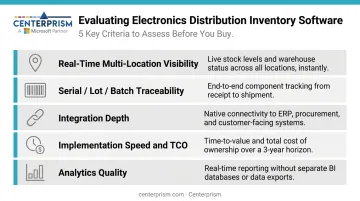
- Real-time inventory visibility with multi-location and multi-warehouse capability
- Electronics-relevant traceability: serial number, lot, and batch tracking
- Integration depth with accounting, CRM, and procurement platforms
- Implementation speed and total cost of ownership
- Quality of analytics for sales and inventory decision-making
Pricing transparency, deployment simplicity, and ongoing support quality were also weighed. For most mid-size electronics distributors, a system that's operational quickly with minimal IT overhead outperforms a complex enterprise platform that requires months of configuration — lost productivity during extended rollouts adds real cost that rarely appears in vendor proposals.
The result is a list that covers a range of distributor profiles — from sub-$1M operations just outgrowing QuickBooks to multi-location distributors ready for a full ERP.
Conclusion
Electronics distribution places a specific combination of pressures on inventory software that generic tools simply aren't designed to handle: high SKU counts, component lifecycle risk, multi-location complexity, and supply chains that can shift overnight. Spreadsheets and disconnected systems don't just create inconvenience — they create the conditions for stockouts, overstocking, missed orders, and customer churn.
Before evaluating any platform, get clear on your actual requirements: how many locations you manage, whether you need serial and lot tracking, how important sales and CRM integration is to your team, and whether a standalone inventory tool or a full ERP better fits where your business is headed.
Prioritize total cost of ownership and scalability over feature count. The most impressive feature list means nothing if implementation takes six months and your team never fully adopts it.
Centerprism's Full Spectrum ERP is built for distributors and wholesalers who need real-time inventory visibility, integrated sales management, and a system they can deploy and run immediately. Call 1-800-814-6631 or visit centerprism.com to find out if it's the right fit for your operation.
Frequently Asked Questions
What is the 80/20 rule for inventory?
The 80/20 (Pareto) rule holds that roughly 80% of a distributor's revenue typically comes from 20% of its SKUs. Electronics distributors apply this through ABC analysis — prioritizing reorder triggers, safety stock, and warehouse placement for high-velocity items while reducing carrying costs on slow-moving components.
What are the 4 types of inventory management systems?
The four main types are periodic, perpetual, just-in-time, and demand-driven/ABC classification-based systems. Electronics distributors typically benefit most from perpetual or demand-driven systems, given the complexity and volatility of their SKU mix.
What features should electronics distributors specifically look for in inventory software?
Prioritize serial and lot number tracking for compliance, component substitution support for obsolescence, real-time multi-location visibility, and integrated CRM tools that connect live inventory data directly to customer order workflows.
How is inventory management software for distributors different from general inventory software?
Distributor-focused software handles multi-location stock management, high-volume order processing, supplier PO automation, and integration with sales and accounting workflows. General inventory tools are typically built for single-location retail or e-commerce environments that don't require this operational depth.
Can inventory management software handle electronic component obsolescence?
Advanced distribution ERP platforms can flag components nearing end-of-life, suggest approved substitutes, and help purchasing teams manage transition timelines. This reduces the risk of holding obsolete stock or losing orders when primary parts become unavailable.
What is the difference between standalone inventory software and a full ERP for electronics distributors?
Standalone inventory software manages stock levels and warehouse workflows in isolation. A full ERP integrates inventory with sales, CRM, purchasing, financials, and analytics in one connected platform — eliminating the data silos that cost distributors time and revenue as they scale.