These aren't edge cases. A 2023 MDM/Sikich survey found that one-third of distributors reported inventory data accuracy below 95% — a gap that cascades into late orders, customer churn, and margin erosion.
This guide covers everything distribution operators need to manage inventory effectively: the definition, the four core inventory management types, the step-by-step process, the KPIs that matter, and the technology that ties it all together.
Key Takeaways
- Distribution inventory management covers purchasing, receiving, storage, fulfillment, and returns across multiple locations simultaneously
- The four primary approaches are periodic, perpetual, just-in-time, and ABC analysis — most distributors use a combination
- Three KPIs drive inventory performance: turnover ratio, order accuracy rate, and carrying cost percentage
- Cloud ERP consolidates real-time visibility and automates replenishment, eliminating the data silos behind reactive purchasing
What Is Distribution Inventory Management?
Distribution inventory management is the process of overseeing, controlling, and balancing the flow of goods — from purchasing and receiving through storage, order fulfillment, and returns — to meet customer demand while minimizing carrying costs.
It's distinct from retail or manufacturing inventory management in one critical way: distributors act as intermediaries. That means managing stock simultaneously across multiple warehouses, customer stockrooms, and transit points, rather than a single production floor or store location. The coordination challenge is fundamentally different.
The core goal is straightforward to state but difficult to execute: maintain optimal stock levels at every node in the distribution network.
Two failure modes sit on either side of that target:
- Excess stock ties up working capital and drives up holding costs
- Too little stock triggers stockouts, missed shipments, and lost customers
Maintaining that balance consistently, across multiple locations and SKUs, is the operational challenge this guide addresses.
Why Inventory Management Is Mission-Critical for Distribution Companies
The Dead Stock Problem Is Widespread
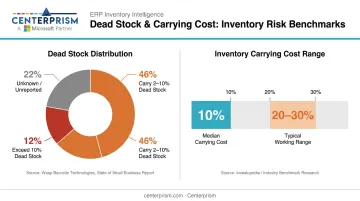
Poor inventory control doesn't just create operational headaches — it destroys margin. According to a 2026 Phocas survey of 100+ wholesale distributors, 46% of respondents carried 2–10% dead stock, while 12% exceeded 10%. Most striking: 22% didn't know their dead-stock level at all.
Inventory that isn't moving still costs money. Storage, insurance, and depreciation accumulate daily. The APQC's 2024 benchmarking data places the median inventory carrying cost at 10% of inventory value across industries — and many supply management professionals target 20–30% as a working range, depending on product type and storage requirements.
Customer Relationships Depend on Reliable Fulfillment
Distributors don't sell directly to end consumers. They sell reliability to retailers, industrial clients, and enterprises who depend on accurate, on-time deliveries to run their own operations. A late shipment or incorrect order doesn't just cost one transaction — it erodes the trust that keeps long-term accounts in place.
Service levels have become a direct competitive differentiator. Customers who experience a stockout or fulfillment error don't usually complain — they quietly shift volume to a competitor. The accounts most at risk are often your highest-value ones, because they have more alternatives.
Key fulfillment risks that erode account retention:
- Stockouts that force customers to source elsewhere and stay there
- Incorrect shipments that delay their production or sales cycles
- Inconsistent lead times that make your inventory unreliable to plan around
Demand Variability Requires More Than Gut Instinct
Distributors serve customers with vastly different order patterns — a national retailer placing weekly bulk orders sits alongside an industrial client with unpredictable project-based purchasing. Add seasonal peaks and supplier lead time variability, and reactive purchasing creates overstock in some SKUs and shortfalls in others almost simultaneously.
Distributors who consistently hit the right stock levels use historical data and software-assisted forecasting. When a key supplier's lead time shifts from three weeks to six, a gut-feel reorder point won't catch it — a system tracking velocity and lead time variance will.
The 4 Types of Inventory Management Distribution Companies Use
Most distributors don't rely on a single approach. The mix depends on product type, order volume, and operational scale. Here's how each method works.
Periodic Inventory Management
Physical stock counts happen at scheduled intervals (weekly, monthly, or quarterly) and records are updated at that point. This approach works for smaller operations with a limited SKU count and relatively stable demand.
The main drawback: the gap between counts creates blind spots. Discrepancies go undetected until the next count, which means decisions made in between are based on stale data. For growing distributors managing dozens of locations, this lag becomes untenable.
Perpetual Inventory Management
Every stock movement (receipts, sales, transfers, returns) is recorded in real time via barcode scanning, RFID, or integrated ERP systems. Records update continuously, eliminating the "count lag" problem.
This is why most growing distributors migrate toward perpetual systems. Accurate reorder triggers depend on knowing current stock levels precisely, not approximately. When a threshold is hit, the system responds, not a warehouse manager checking a spreadsheet three days later.
Just-in-Time (JIT) Inventory Management
JIT means ordering stock only as it's needed, minimizing warehouse holding costs and reducing capital tied up in unsold goods. Lean operations with lower carrying costs make it attractive — but the exposure is real.
A 2023 Production and Operations Management study noted that pandemic-era disruptions exposed JIT's vulnerability when supplier buffers are too thin. MDM/Sikich's 2023 distribution research echoed this: "Just-in-time is too prone to disruption to remain the industry standard in the post-pandemic world."
JIT works best when supplier lead times are short, demand is predictable, and you have strong supplier relationships. Without those conditions, it creates fragility.
ABC Analysis (The 80/20 Rule in Practice)
That fragility points to a broader challenge: not all inventory deserves equal attention. ABC analysis addresses this directly, segmenting SKUs into three tiers based on value and velocity:
- A items: roughly 20% of SKUs generating ~80% of revenue; these get tight controls, higher safety stock, and frequent monitoring
- B items: moderate value and demand; managed with standard oversight
- C items: low value or slow-moving; lighter oversight, minimal safety stock
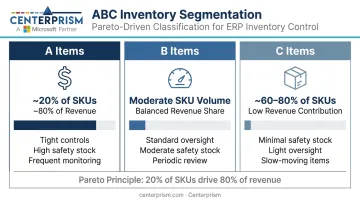
The logic follows the Pareto principle: focus your tightest inventory controls where they generate the most return. A distributor managing thousands of SKUs can't treat every item the same — ABC analysis gives you a rational framework for deciding where to concentrate attention and capital.
The Step-by-Step Distribution Inventory Management Process
Effective inventory management isn't a single task — it's a continuous cycle. Here's how the phases connect.
Demand Forecasting and Procurement Planning
The cycle starts before stock is ordered. Analyzing historical sales data, customer order patterns, seasonality, and market trends gives purchasing teams a reliable basis for procurement decisions.
For distributors with diverse customer bases, demand variability is higher than in single-channel operations. Software-assisted forecasting catches patterns that manual review misses — reducing both over-ordering (which creates carrying cost) and under-ordering (which creates stockouts).
Key inputs for effective demand forecasting include:
- Historical sales data segmented by SKU and customer segment
- Seasonal demand curves and promotional calendars
- Supplier lead times and minimum order quantities
- Current carrying costs and warehouse capacity constraints
Receiving, Categorization, and Warehouse Allocation
Incoming shipments get inspected, logged against purchase orders, and categorized by SKU, batch, lot, or expiration date. For multi-warehouse operations, allocation decisions made at this stage matter: routing inventory to the location with the highest regional demand shortens delivery windows and reduces transfer costs later.
Getting this step right prevents downstream errors — a mislabeled receipt or miscounted pallet will cause problems at fulfillment and show up in KPI reports.
Real-Time Inventory Tracking and Monitoring
Once stock is in the warehouse, ongoing tracking takes over. The goal is knowing current stock levels, item locations, and movement across all sites without manual polling.
Automated low-stock alerts and reorder-point triggers replace reactive monitoring. Instead of a warehouse manager noticing a shortage after a customer already called, the system flags the gap and initiates replenishment proactively.
Order Processing, Fulfillment, and Reverse Logistics
Fulfillment priorities are accuracy and speed. Bulk orders and small-scale orders often require different picking workflows — forcing both through the same process slows throughput and increases pick errors.
Reverse logistics deserves equal attention. Returned goods must be assessed quickly and either restocked, refurbished, or disposed of according to documented policies. In regulated industries, returns handling isn't optional — it's compliance.
Performance Analysis and Continuous Improvement
Execution data from fulfillment, receiving, and returns feeds directly into the next phase: analysis. After each operating period, reviewing KPIs reveals where the cycle broke down. Was it a forecasting miss? A fulfillment error rate spike? An unexpected carrying cost increase? Identifying the source of each inefficiency — not just the symptom — is what drives margin improvement over time.
The most actionable KPIs to review after each period:
- Order accuracy rate: Percentage of orders fulfilled without errors or corrections
- Inventory turnover ratio: How often stock cycles through relative to carrying cost
- Stockout frequency: How often demand outpaced available inventory
- Return rate by SKU: Flags quality, forecasting, or fulfillment issues at the product level
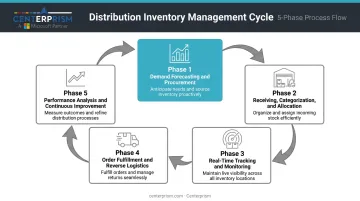
Distributors who formalize this review — even a monthly KPI walkthrough — close the loop on the cycle and carry the findings into the next forecasting round.
Key Inventory KPIs Every Distributor Should Track
Three metrics give distribution managers the data to make proactive decisions. Track them regularly, not just at year-end.
Inventory Turnover Ratio
Formula: Cost of Goods Sold ÷ Average Inventory Value
A high ratio means stock moves efficiently. A low ratio signals overstocking or weak demand forecasting. For current context: the U.S. Census Bureau's April 2026 monthly wholesale trade report shows merchant wholesaler inventories of $940.3B against sales of $789.1B — an inventories-to-sales ratio of 1.19.
Use your own ratio trends over time as the primary benchmark. A rising ratio typically means tighter operations; a declining one warrants a closer look at purchasing and forecasting practices.
Order Accuracy Rate
Definition: Percentage of orders fulfilled correctly and completely
According to WERC DC Measures data cited by Yale's 2025 white paper, best-in-class distribution centers achieve order-picking accuracy of 99.68% or higher. Median performers land around 99.30%.
Falling below 99% triggers a cascade of problems:
- Customer complaints and reputational damage
- Return processing costs and replacement shipments
- Strained relationships with high-value accounts
Barcode scanning and integrated ERP systems drive the biggest improvements in this metric.
Inventory Carrying Cost Percentage
Formula: Total Holding Costs ÷ Total Inventory Value
This KPI exposes the hidden cost of overstock and slow-moving SKUs. Every percentage point of unnecessary carrying cost represents capital that isn't being deployed elsewhere.
Reducing this metric starts with better demand forecasting and ABC prioritization. Deprioritizing C items frees up warehouse space and cuts the insurance, storage, and obsolescence costs that build up over time.
Best Practices and Technology for Smarter Inventory Management
Three Practices That Move the Needle
Apply ABC analysis consistently — Focus monitoring, capital allocation, and safety stock on A items. Don't apply the same overhead to slow-moving C items that you apply to your highest-velocity SKUs.
Automate reorder points — Manual reorder processes create a lag between when stock runs low and when a purchase order is generated. Automated triggers eliminate that gap and remove the human error that comes with reactive purchasing.
Diversify suppliers and maintain calculated safety stock — A 2021 Gartner survey of 1,328 supply chain professionals found that 43% were actively investing in safety stock as a disruption buffer. Building safety stock levels based on demand variability and supplier lead time — rather than gut feel — protects service levels without chronic overstocking.
These practices only hold up when your systems can support them. That's where ERP technology becomes the operational foundation.
How ERP Systems Elevate Distribution Inventory Management
Most distribution inventory problems trace back to fragmented data. Purchasing data lives in one system. Warehouse data lives in another. Sales and accounting don't talk to either. The result is the visibility gap that drives reactive decisions.
Cloud-based ERP solves this by consolidating inventory tracking, purchasing, order management, and financial reporting into a single platform. The specific capabilities that matter most for distributors:
- Tracks stock across multiple locations in real time — no waiting for a count
- Fires automated replenishment triggers tied directly to live inventory data
- Generates demand forecasts from trend data, not memory or guesswork
- Connects inventory decisions to margin data through native sales and accounting integration
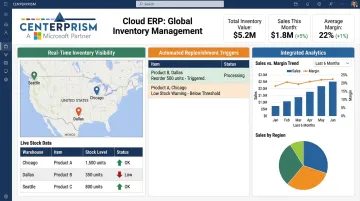
Centerprism's Full Spectrum ERP serves distributors and wholesalers on Microsoft Dynamics GP, with same-day plug-and-play implementation. There's no months-long deployment — the platform installs and operates on day one without requiring a separate BI database.
Its PrismView analytics tool pulls real-time visibility into sales trends, best sellers, and profit margins directly from the live database. For distribution teams making daily purchasing and fulfillment calls, the difference between live data and yesterday's spreadsheet export is exactly where reactive decisions get replaced with informed ones.
Frequently Asked Questions
What is distribution inventory management?
Distribution inventory management is the process of tracking, controlling, and optimizing inventory levels across a distribution company's warehouses, transit points, and customer locations. The goal is meeting demand efficiently while minimizing carrying costs across every node in the network.
What is the role of inventory management in distribution?
Inventory management ensures products are available in the right quantities at the right locations. It reduces carrying costs, supports accurate order fulfillment, and enables the supply chain coordination that keeps customer relationships intact.
What are the 4 types of inventory management?
The four primary types are:
- Periodic — scheduled physical counts at set intervals
- Perpetual — real-time tracking of every stock movement
- Just-in-time — demand-driven ordering to minimize holding costs
- ABC analysis — priority-based classification by value and velocity
Most distributors use a combination of these approaches.
What is the 80/20 rule in inventory?
The Pareto principle applied to inventory: roughly 20% of a distributor's SKUs typically generate 80% of revenue. ABC analysis puts this into practice — A items get the tightest controls and highest safety stock, while C items receive lighter oversight.
What are the biggest inventory management challenges for distributors?
The top challenges are multi-location stock visibility, inaccurate demand forecasting across a diverse customer base, high carrying costs from overstock, and supply chain disruptions. These issues tend to compound — poor visibility produces bad forecasts, which drives excess stock or stockouts and erodes both margins and customer trust.
How does ERP software improve inventory management for distribution companies?
ERP replaces disconnected spreadsheets and manual counts with real-time visibility across all locations, automated reorder triggers, and integrated analytics. Distributors can make faster, data-backed purchasing and fulfillment decisions — and catch problems before they become customer-facing failures.