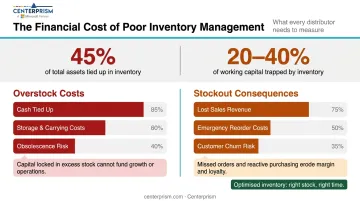
According to Modern Distribution Management, one-third of distributors have inventory accuracy below 95%, and more than 75% report fill rates below 95%. Those gaps aren't just operational headaches — they directly erode margins and customer relationships.
Distributor inventory management software solves this by unifying stock tracking, order processing, and sales data in a single system built for how distributors actually work. This guide covers the top solutions available to US-based distributors, the features that matter most, and what to evaluate before committing.
Key Takeaways
- Distributor inventory software automates stock tracking, order fulfillment, and demand forecasting — eliminating the manual errors that drain margins
- Real-time multi-location visibility, integrated CRM, and automated replenishment are non-negotiable features for most distributors
- Implementation timelines range from months (enterprise ERPs) to same-day deployment with purpose-built platforms like Centerprism
- Match the platform to your business size and distribution model — not just the feature list
- Accounting integration and distributor-specific tools — tiered pricing, commission management — determine long-term fit
What Is Distributor Inventory Management Software?
Distributor inventory management software is a specialized business management system that tracks stock levels in real time, automates reordering, and integrates with order management, sales, and accounting functions. It's built for the workflows of distributors and wholesalers — not generic retailers or e-commerce businesses.
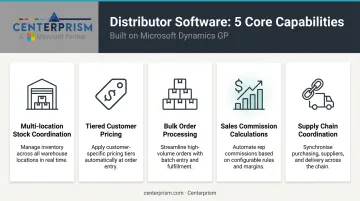
Standard inventory tools simply track quantities. Distributor-specific software goes further, handling:
- Multi-location stock coordination across warehouses and fulfillment points
- Tiered customer pricing and contract-specific rates
- Bulk order processing and high-volume fulfillment
- Sales rep commission calculations
- Supply chain coordination with vendors and carriers
That expanded scope is driving real adoption. The inventory management software market is projected to grow from $3.44B in 2026 to $5.16B by 2031 at an 8.45% CAGR — a signal of how urgently distributors are moving away from manual processes and disconnected systems toward purpose-built solutions.
Top Distributor Inventory Management Software Solutions
The platforms below were evaluated on real-time inventory capabilities, ease of implementation, integration depth, distributor-specific features, scalability, and user feedback across the US market.
Centerprism
Centerprism is a Full Spectrum ERP built specifically for US distributors and wholesalers — covering industrial distributors, consumer goods wholesalers, and rental supply companies. It combines inventory management, CRM, sales management, and analytics in a single platform with same-day plug-and-play installation.
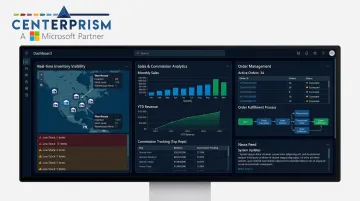
PrismView connects directly to the live database with no separate BI database or configuration required, so distributors are fully operational the day the system is deployed. It surfaces real-time sales trends, best sellers, and profit margins without spreadsheet exports.
Beyond analytics, Centerprism covers the full distribution workflow:
- Wireless Warehouse : smartphone-based barcode scanning with real-time database connectivity, no proprietary handheld hardware required
- Automated Receivables — customer payment portal, cash receipts dashboard with integrated credit card processing, and a collection management system with automated reminders and escalation templates
- Advanced Sales Commissions — customizable plans per salesperson, including tiered rates, salesperson splits, paid invoice commissions, product spiffs, and a sliding depreciation scale that adjusts commissions based on invoice aging
- Rule-based Product Configurator — guides order entry through custom product builds via a step-by-step Q&A process, supporting stocked items, kits, and assemblies
| Detail | Info |
|---|---|
| Key Features | Real-time inventory visibility, PrismView analytics, integrated CRM, automated receivables, rule-based product configurator, advanced commissions module, wireless warehouse |
| Pricing | Contact Centerprism at 1-800-814-6631; same-day implementation included |
| Best For | Industrial distributors, consumer wholesalers, and rental supply companies seeking a full-spectrum ERP with rapid deployment |
NetSuite ERP
NetSuite (Oracle) is an enterprise-grade cloud ERP used by large and fast-growing distributors to centralize inventory, order management, warehouse operations, and financial reporting across multiple locations. It handles multi-entity operations, complex pricing, and high-volume fulfillment in a single system.
Key capabilities include:
- Demand-based inventory planning using historical trends
- Built-in WMS for picking, packing, and shipping
- Multi-currency and multi-entity financial management
- Real-time supply chain visibility across EDI and online channels
NetSuite was named a Leader in the IDC MarketScape 2023–2024 for SaaS and Cloud-Enabled Midmarket Finance and Accounting Applications.
| Detail | Info |
|---|---|
| Key Features | Multi-location inventory, built-in WMS, demand forecasting, order-to-cash automation, supply chain visibility, EDI support |
| Pricing | Custom pricing; requires consultation |
| Best For | Large or rapidly scaling distributors needing enterprise-grade financial control and end-to-end supply chain management |
Acumatica
Acumatica is a cloud ERP with a dedicated Distribution Edition for mid-market distributors. Its consumption-based pricing model — charged by transaction volume rather than per user seat — keeps costs predictable as teams grow.
Core capabilities include:
- Real-time inventory visibility across warehouses and sales channels
- Automated replenishment with barcode scanning
- Role-based dashboards with cost control by warehouse, product line, or business unit
- Open API supporting integrations with CRM, e-commerce platforms, EDI, Shopify, and Amazon
| Detail | Info |
|---|---|
| Key Features | Multi-warehouse inventory, automated replenishment, cost control by location, open API, flexible deployment |
| Pricing | Custom consumption-based pricing; no fixed seat cost; implementation typically requires a certified partner |
| Best For | Mid-market distributors needing a scalable cloud ERP with strong distribution-specific modules and integration flexibility |
Cin7 Core
Cin7 Core is a cloud-based inventory and order management platform for growing distributors managing stock across multiple warehouse locations. It connects inventory, purchasing, sales, and fulfillment with strong automation capabilities and over 700 app integrations.
Standout features include automated purchase orders triggered by configurable reorder points, batch/lot/serial number tracking for full product traceability, and a B2B self-service ordering portal that lets wholesale buyers search products, compare prices, and complete transactions independently.
| Detail | Info |
|---|---|
| Key Features | Multi-warehouse tracking, automated POs, product traceability, B2B portal, accounting integrations (Xero, QuickBooks, Shopify, Amazon) |
| Pricing | Starts at $349/month (verify current pricing at cin7.com) |
| Best For | Growing distributors managing multiple warehouses who need strong automation and accounting integration without a full enterprise ERP |
Fishbowl
Fishbowl is a warehouse and inventory management platform popular among small to mid-size distributors who rely on QuickBooks for accounting. It provides practical inventory control without the complexity or cost of a full ERP.
Fishbowl's deep QuickBooks and Xero integration automatically syncs inventory and financial data, making it the go-to choice for businesses that want to extend their existing accounting setup rather than replace it. Barcode scanning, automated reorder points, purchase order generation, and lot/serial number tracking complete the platform's core capabilities.
| Detail | Info |
|---|---|
| Key Features | QuickBooks integration, barcode scanning, automated reorder, lot/serial tracking, multi-location inventory |
| Pricing | Starts at $229/month billed annually (verify current pricing at fishbowlinventory.com) |
| Best For | Small to mid-size distributors needing tight QuickBooks integration and warehouse management without migrating to a full ERP |
Key Features to Look For in Distributor Inventory Management Software
Real-Time, Multi-Location Stock Visibility
The software must deliver live inventory counts across all warehouses, delivery vehicles, and fulfillment points. Nightly batch updates don't cut it when orders are processed throughout the day.
Stale data has direct consequences: overpromising customers on in-stock items, missing reorder windows, and carrying positions that don't reflect reality. Industry data shows roughly one-third of distributors operate below 95% inventory accuracy — a gap that traces back to systems that can't keep pace with actual stock movement.
Automated Replenishment and Demand Forecasting
Configurable reorder points by SKU and location that auto-trigger purchase orders before stockouts occur are a baseline requirement. Reactive reordering is a margin problem — especially for distributors operating on thin spreads.
The financial stakes are significant. MDM reports that inventory can account for 45% of total assets and trap 20% to 40% of working capital for distributors. Effective demand forecasting using historical sales data can reduce both overstock positions and stockout frequency.
Integration with Accounting, ERP, and Sales Tools
Inventory data siloed from financials creates reconciliation work, reporting delays, and invoice errors. The platform should connect natively or via API with:
- Accounting software (QuickBooks, Xero) for synchronized invoicing and payments
- CRM systems so customer accounts reflect current stock availability
- Order management workflows to eliminate manual re-entry across channels
Distributor-Specific Functionality
Generic inventory apps are built for retail. Distribution software should handle:
- Customer-specific pricing tiers for different account types or contract terms
- Customizable sales commission plans calculated per salesperson
- Integrated CRM that ties inventory visibility to customer accounts and pipeline activity
- Rental inventory tracking for distributors with equipment rental operations
A platform missing these capabilities will require workarounds — or won't fit a distribution business model at all.
How We Chose the Best Distributor Inventory Management Software
A common mistake in software evaluation is prioritizing feature count over operational fit. Many platforms built for retail or e-commerce lack the distribution-specific logic that actually matters: tiered pricing, multi-warehouse coordination, commission management, and high-volume order processing.
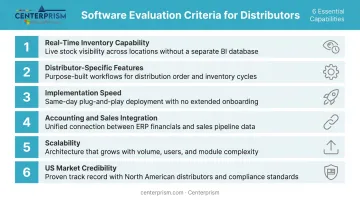
We focused our evaluation on:
- Real-time inventory capability — live, multi-location stock visibility
- Distributor-specific features — order management, CRM, commissions, rental management
- Implementation speed — Panorama's 2026 ERP Report found more than 25% of ERP projects go over budget and nearly 25% exceed planned timelines, making this a hard cost factor, not a soft preference
- Accounting and sales tool integration — native connections rather than workarounds
- Scalability — for growing SKU counts, additional warehouse locations, and expanding teams
- US market credibility — established user base and support infrastructure for US-based distributors
Those implementation stats aren't abstract. Gartner projects that by 2027, more than 70% of recently completed ERP initiatives will fall short of their original business-case goals. That failure rate is largely driven by poor operational fit — not insufficient features. Every platform reviewed here was evaluated against real distribution workflows, not a generic checklist.
Conclusion
The right distributor inventory management software isn't just a stock-tracking tool. It's the operational and sales intelligence layer connecting inventory, customers, and revenue in real time. Choosing a platform aligned with your specific distribution model — industrial, consumer wholesale, or rental — matters more than choosing the most recognized brand.
Before committing, evaluate implementation timelines honestly, confirm how the platform handles multi-warehouse coordination, and verify that inventory data connects tightly to sales and financial reporting.
For US-based distributors and wholesalers looking for a full-spectrum ERP with same-day deployment, real-time analytics, and built-in sales management, Centerprism delivers same-day implementation with no separate database required. Call 1-800-814-6631 or visit centerprism.com.
Frequently Asked Questions
What is distributor inventory management software?
It's a specialized platform that automates stock tracking, order fulfillment, and demand forecasting across multiple locations — built for the workflows of distributors and wholesalers rather than retail or e-commerce. Purpose-built platforms handle the pricing structures, warehouse coordination, and supply chain complexity that generic tools simply aren't designed for.
How is distributor inventory management software different from standard inventory software?
Distributor-specific platforms handle multi-warehouse coordination, tiered customer pricing, bulk order processing, sales rep management, and supply chain visibility. Generic inventory tools are designed for simpler, single-location retail environments and lack these distribution-critical capabilities.
What features should I look for in inventory management software for distributors?
Prioritize real-time multi-location visibility, automated reorder triggers, native accounting integration (QuickBooks, Xero), distributor-specific pricing and CRM tools, commission management, and mobile access for warehouse and field teams.
Can distributor inventory management software integrate with accounting systems like QuickBooks?
Most modern platforms offer native or API-based integration with QuickBooks, Xero, and similar accounting tools. Stock movements, invoices, and payments stay aligned automatically — no manual reconciliation required.
What is the difference between ERP and inventory management software for distributors?
Inventory software focuses on stock control and order fulfillment. A distributor ERP covers the full business — financials, CRM, procurement, sales commissions, analytics, and warehouse management — replacing a patchwork of connected tools with one unified platform.
How long does it take to implement distributor inventory management software?
Timeline depends on platform and business complexity. Enterprise ERPs like NetSuite typically require months of implementation. Purpose-built platforms like Centerprism offer same-day deployment — making warehouse count and data complexity the real variables, not the software itself.