Introduction
Running a wholesale distribution business means juggling bulk orders, negotiated pricing for dozens of accounts, multiple sales channels, and fulfillment requirements that shift daily. When those moving parts are managed through spreadsheets, email threads, and disconnected systems, the cracks show fast — in missed orders, pricing errors, and frustrated customers who quietly switch suppliers.
The stakes are real. Research reported by Digital Commerce 360 found that B2B buyers experience errors on 33% of online orders, and 74% would switch suppliers for a better buying experience. For high-value wholesale accounts, a single fulfillment failure can end a long-term relationship.
This guide breaks down what wholesale order management actually is, where growing operations typically run into trouble, and how to audit and strengthen the workflows that keep your orders — and customer relationships — on track.
Key Takeaways
- Wholesale order management spans four stages: order capture, processing and validation, fulfillment, and post-order management
- Manual workflows create pricing errors, fulfillment delays, and customer churn at scale
- A purpose-built OMS automates customer-specific pricing, exception routing, and multi-channel order intake — removing the manual bottlenecks that slow fulfillment
- Real-time inventory visibility across locations prevents overselling on bulk orders
- Automating invoicing and collections accelerates cash flow and reduces finance team workload
What Is Wholesale Order Management?
Wholesale order management is the end-to-end process of receiving, validating, fulfilling, and tracking bulk B2B orders — from the moment a purchase order arrives through invoicing, payment collection, and delivery. It covers the people, processes, and systems that keep every step of that lifecycle on track.
How Wholesale Differs from Retail Order Management
Retail order management handles high volumes of fixed-price, single-party transactions. Wholesale operates by a different set of rules:
- Customer-specific pricing — negotiated price lists, volume tiers, and promotional rates that vary by account
- Minimum order quantities (MOQs) — rules that must be validated at intake, not discovered after the order is confirmed
- Credit terms and limits — net-30, net-60, or custom arrangements that require credit checks before fulfillment begins
- Orders that may need sign-off from sales managers, finance, or ops before processing kicks off
- Partial fills, substitutions, backorders, and returns that each require their own resolution workflow
Consumer-facing ecommerce platforms aren't designed for any of this. They handle transactions; they don't manage accounts.
The Role of a Wholesale OMS
A Wholesale Order Management System is the software layer that automates and centralizes order capture, pricing validation, inventory checks, routing, and fulfillment across every channel. It connects with ERP, CRM, accounting, and warehouse tools so sales, operations, and finance all work from the same data.
Without that shared source of truth, each team maintains its own version of an order's status — and reconciling those versions is where time and money quietly disappear.
The Wholesale Order Management Process: 4 Key Stages
Despite differences in product lines, business models, and customer types, wholesale order management follows a consistent lifecycle. Each stage carries its own failure points and automation opportunities.
Stage 1: Order Capture
Order capture is the entry point where orders arrive from multiple channels:
- EDI feeds from large retail accounts
- B2B self-service portals
- Sales rep applications
- Phone or email
- Trade show intake
The challenge isn't volume — it's receiving orders accurately across all of these simultaneously.
Without a centralized system, teams manually re-key orders from email into their ERP, transfer EDI files, and reconcile pricing from different sources. Each hand-off is an opportunity for error. A unified order capture layer eliminates that manual re-entry, enforcing consistent pricing and data completeness regardless of how the order arrived.
Stage 2: Order Processing and Validation
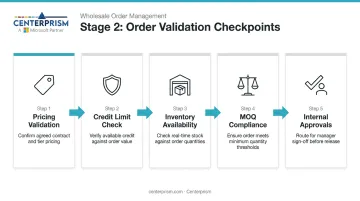
Once captured, every order needs to be checked before it's confirmed. This stage includes:
- Pricing validation — confirming the order reflects the customer's negotiated rates, not list price
- Credit limit checks — flagging orders that would exceed a customer's approved credit
- Inventory availability — confirming stock before committing to a delivery date
- MOQ compliance — catching orders that fall below minimum thresholds
- Internal approvals — routing exceptions to the right person with a clear deadline
Generic shopping cart tools often push these checks outside the workflow, creating a backlog of exceptions that stall fulfillment. An OMS built for wholesale handles them within the system — so every exception has an owner, a resolution path, and a deadline attached.
Stage 3: Fulfillment and Shipping
Validated orders route to the appropriate warehouse or 3PL, where items are picked, packed, and handed off to carriers. In multi-warehouse operations, automated routing logic — based on stock availability, warehouse proximity, and shipping cost — determines where an order ships from. Getting this wrong means delayed fulfillment or unnecessary freight expense.
Real-time inventory allocation also prevents two orders from being committed to the same stock. For high-value bulk orders, that kind of double-allocation is a much costlier problem than it would be in retail.
Stage 4: Post-Order Management
The order doesn't end at shipment. Post-order management covers the final steps that directly affect cash flow and account relationships:
- Invoicing — automated delivery immediately after shipment, eliminating delays
- Collections — structured workflows with reminders, payment portals, and tracked communications
- Returns and RMAs — structured processing to resolve disputes without derailing fulfillment
- Order status updates — proactive communication back to buyers at each stage
For businesses managing hundreds of accounts, the gap between shipment and payment is where cash flow gets squeezed. Automating these steps closes that gap consistently.
Core Challenges in Wholesale Order Management
Pricing and Volume Complexity
Every wholesale account can have its own pricing universe — negotiated rates, volume tiers, pack-size rules, and promotional pricing that changes by period or order size. Without automated validation at order intake, pricing errors slip through undetected until invoicing, when they're much harder to resolve.
The Hackett Group found that organizations with formal end-to-end order-to-cash process ownership have 55% lower process costs than their peers. Much of that gap comes from eliminating the rework caused by pricing and data errors that manual processes let through.
Multi-Channel Order Complexity
B2B buyers interact with sellers through multiple channels — Salesforce research cited by the Distribution Strategy Group puts the number at 10 distinct channels for a typical business buyer. For wholesale distributors, that means orders arriving via EDI, portals, rep apps, phone, email, and counter sales — each with different data formats and workflows.
Without a unified system, teams manually reconcile these streams. According to Conexiom's industry snapshot, the average customer service rep spent up to 4 hours per day manually typing sales orders — time that isn't going toward serving customers or resolving exceptions.

Inventory Visibility Across Locations
When stock is distributed across multiple warehouses, 3PL facilities, or dropship partners, real-time accuracy becomes critical. Without real-time visibility, wholesalers risk:
- Overselling on bulk orders when stock is already allocated elsewhere
- Stockouts that delay shipments to key accounts
- Inaccurate available-to-promise dates that erode buyer trust
ASCM notes that high inventory inaccuracy leads directly to unexpected backorders, dissatisfied customers, and higher operational costs — a compounding problem, since the accounts most likely to place bulk orders are also the ones with the least tolerance for fulfillment failures.
Fragmented Systems
When ERP, CRM, accounting, WMS, and sales tools don't communicate, every team maintains its own data — and reconciling those versions requires manual effort that doesn't scale. MHI's annual industry report found that 55% of supply chain leaders increased technology and innovation budgets, with 60% of those planning to spend over $1 million — largely to address exactly this integration problem.
Exception Handling Overhead
Partial fills, substitutions, backorders, and credit holds are normal in wholesale. The problem isn't that they occur — it's that without structured routing, they pile up in inboxes with no clear owner, no deadline, and no audit trail.
Common exceptions that stall fulfillment cycles include:
- Partial fills requiring split shipment decisions
- Substitutions needing customer approval before processing
- Backorders with no escalation path or ETA
- Credit holds blocking orders without notifying the sales rep
Each one handled manually adds time to the fulfillment cycle and creates gaps in the customer experience that compound across high-volume accounts.
Essential Features of a Wholesale Order Management System
Not all OMS platforms are built for B2B complexity. These are the capabilities that matter most for wholesale operations.
Multi-Channel Order Capture
A capable OMS accepts orders from every intake channel (EDI, rep apps, B2B portals, CSV uploads, email) and centralizes them in a single dashboard. This eliminates the manual reconciliation that fragments pricing consistency and creates inventory discrepancies between channels.
Customer-Specific Pricing and Catalog Management
Wholesale pricing is inherently account-specific. The system must support:
- Negotiated price lists per customer or account group
- Volume-based discount tiers
- Price memorization for repeat transactions
- Custom product catalogs and rule-based product configuration
Centerprism's Price Management and Price Memorization modules store customer-specific and historical pricing rules so agreed-upon rates apply automatically during order entry, eliminating manual lookups on recurring orders.
The Sales Configurator extends this further, walking order entry staff through a rule-based Q&A process to configure custom products (size, material, finish, add-ons) that flow cleanly into the order pipeline.
Real-Time Inventory Visibility and Allocation
Live stock levels across all warehouses and locations, backed by automatic allocation logic, prevent overselling and keep backorder management from becoming a manual fire drill. Centerprism's PrismView™ analytics tool provides a real-time database connection with no separate BI infrastructure required, so distributors get live inventory and sales data without scheduled exports or database maintenance overhead.
Workflow Automation and Approval Routing
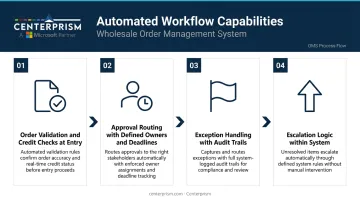
Built-in automation keeps the order pipeline moving without manual hand-offs. Key automation capabilities include:
- Order validation and credit checks at entry
- Approval routing with defined owners and deadlines
- Exception handling with audit trails
- Escalation logic that stays inside the system, not buried in email threads
Integrated CRM and Accounting
Order data, financial records, and customer information need to stay synchronized without duplicate entry across disconnected systems.
Centerprism's CRM is a native component of the same platform as its order management tools. Sales teams can access customer analytics, order history, and receivables status (including outstanding invoices and collections activity) within a single session, without toggling between applications.
Best Practices to Improve Wholesale Order Management
Centralize All Order Channels
Route every order, regardless of channel, through one platform. This single source of truth prevents the pricing inconsistencies and inventory gaps that emerge when different channels operate in silos.
Distributors running disconnected tools should evaluate whether a full-spectrum ERP like Centerprism (designed for same-day implementation with no separate database required) can consolidate their operations faster than a traditional multi-month rollout.
Automate Exception Handling with Structured Workflows
Define clear rules for how pricing discrepancies, credit holds, substitutions, and partial fills are routed and resolved. Each exception should have:
- An assigned owner
- A resolution deadline
- A complete audit trail
Removing exceptions from email and into structured digital workflows is where teams reclaim the most time.
Use Analytics to Move from Reactive to Proactive
Real-time dashboards turn raw order data into decisions. They should surface:
- Sales trends by customer, product, or rep
- Best-selling SKUs and margin performance
- Inventory levels relative to demand patterns
- Salesperson performance against targets
Centerprism's PrismView™ surfaces sales trends, best sellers, profit margins, and year-over-year comparisons in real time, without spreadsheet exports. That means managers are working from current numbers, not data that was accurate three days ago.
Frequently Asked Questions
What is wholesale order management?
Wholesale order management is the end-to-end process of receiving, validating, fulfilling, and tracking bulk B2B orders — from order capture and pricing validation through fulfillment, invoicing, and returns. It combines people, processes, and technology across the full order lifecycle.
What are the 4 stages of order management?
The four stages cover the complete order lifecycle:
- Order Capture — receiving orders across all channels
- Order Processing and Validation — pricing checks, credit checks, and approvals
- Fulfillment and Shipping — routing, picking, packing, and dispatch
- Post-Order Management — invoicing, payment collection, returns, and status updates
What is the difference between a CRM and an OMS?
A CRM manages customer relationships, contact history, and sales pipelines. An OMS manages the operational lifecycle of individual orders from capture through fulfillment. In wholesale, the two work best when integrated — so sales teams see order history and account status alongside customer data in one platform.
How does wholesale order management differ from retail?
Wholesale involves bulk orders, negotiated pricing tiers, MOQs, credit terms, multi-party approvals, and complex exception handling. Retail transactions are typically fixed-price, high-volume, and single-party — far simpler by comparison.
What are the biggest challenges in wholesale order management?
The most common pain points include:
- Customer-specific pricing complexity
- Multi-channel order intake requiring manual reconciliation
- Real-time inventory visibility across locations
- Fragmented systems that create duplicate data entry
- Exceptions like partial fills and backorders with no structured workflow
What should I look for when choosing a wholesale OMS?
Focus on these six capabilities:
- Multi-channel order capture
- Customer-specific pricing and catalog support
- Real-time inventory visibility
- ERP and accounting integrations
- Workflow automation for approvals and exceptions
- Mobile access for field sales teams