The problem most distributors run into: mainstream CRMs were designed for software and services companies, not for businesses where customer relationships, inventory levels, and order history need to live in the same system. Choosing the wrong tool often means months of expensive consultant work before a single rep sees any value.
This guide covers the five best CRM platforms for wholesale distributors in 2026 — evaluated against the operational realities of distribution, not just feature checklists.
Key Takeaways
- Distribution-specific CRMs consistently outperform generic tools on user adoption and sales rep productivity
- ERP integration, real-time analytics, and mobile access are non-negotiable for field-driven distribution teams
- Total cost of ownership routinely exceeds licensing fees once implementation, consultants, and add-on modules are factored in
- Same-day deployment is now a real differentiator as distributors demand faster time to value
- This guide covers five CRMs spanning SMB to enterprise, including both standalone and ERP-native options
Why Wholesale Distributors Need a Purpose-Built CRM
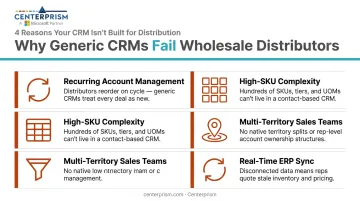
Most distribution businesses don't fit the customer profile that mainstream CRMs were built around. A few reasons why generic tools underperform:
- Recurring account management — Distribution revenue comes from existing accounts reordering, not constant new-logo acquisition. Most CRM pipelines are built for the latter.
- High-SKU complexity — DSG's 2025 e-commerce study found electrical distributors operating with 100,000+ SKU catalogs. Quote accuracy and cross-sell recommendations depend on live product data, not a disconnected catalog.
- Multi-territory sales teams — Field reps need territory management, commission tracking, and mobile access. These aren't standard in generic CRMs.
- Real-time ERP sync — Customer data that doesn't connect to inventory and order management creates blind spots that cost sales.
According to Distribution Strategy Group's CRM research, only 50% of sales reps and sales leaders regularly use their CRM — not because CRMs are unavailable, but because most systems don't return actionable value to the reps entering data. The data entry burden exists, but the return on that effort doesn't — and reps stop using tools that don't help them sell.
That same DSG research found distribution-specific CRMs score measurably higher in user satisfaction than ERP-provided modules or custom-built systems — which makes platform selection one of the most consequential decisions a distributor can make.
Best CRM Software for Wholesale Distributors in 2026
Selections were evaluated on ERP integration depth, implementation speed, distributor-specific functionality, pricing transparency, and suitability across business sizes.
Centerprism – Full Spectrum ERP with Integrated CRM
Centerprism is an ERP platform purpose-built for US-based distributors and wholesalers — including industrial distributors, consumer wholesalers, and rental supply companies. Its CRM module isn't a separate tool bolted onto an ERP; it's woven directly into order management, inventory, and financial workflows from day one.
What sets Centerprism apart:
- Same-day deployment: Connects directly to the live Dynamics GP database with no separate database required. Distributors go live the same day, skipping the months-long rollouts common with other platforms.
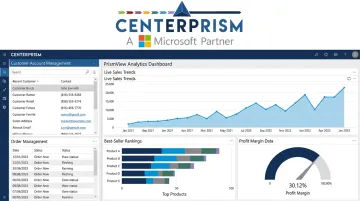
- PrismView real-time analytics: Live sales trends, best-seller rankings, and profit margin views by customer, item, salesperson, or vendor. Split-screen year-over-year comparisons available out of the box, no spreadsheet exports needed.
- Automated receivables and collections: Tracks customer communications, sends automated payment reminders, supports batch email invoicing, and integrates credit card processing within the same platform.
- Advanced sales commissions: Configurable plans per salesperson, including tiered rates, salesperson splits, product spiffs, and a sliding depreciation scale tied to invoice aging.
The CRM-to-cash-flow connection is particularly relevant for distributors: when a salesperson's commission is adjusted based on how quickly their accounts pay, the sales team has a direct financial stake in the customer relationship beyond the initial order.
| Category | Details |
|---|---|
| Key Features | Integrated CRM + ERP, PrismView real-time analytics, automated receivables, credit card processing, rule-based product configurator, customizable sales commission plans |
| Pricing | Contact Centerprism at 1-800-814-6631; same-day implementation included |
| Best For | Industrial distributors, consumer wholesalers, and rental supply companies seeking an all-in-one ERP+CRM with zero-delay deployment |
Salesforce
Salesforce is the most widely deployed CRM globally, used by large wholesale distributors that need a highly configurable platform capable of spanning multiple departments and regions. Its ecosystem covers thousands of integrations, an extensive partner network, and AI capabilities through Einstein , giving it broader third-party coverage than any other CRM on this list.
The tradeoff is significant. A Forrester TEI study on Salesforce for Manufacturing modeled $7.67M in three-year costs for a $2.3B manufacturer, with implementation and integration alone taking 7 to 24 months. While that's a manufacturing context, the complexity is comparable for multi-region distribution operations. Most distributors will need external consultants or dedicated internal resources to configure Salesforce for distribution workflows (factor that into the total cost before comparing licensing tiers).
| Category | Details |
|---|---|
| Key Features | Workflow automation, advanced reporting, AI-powered insights (Einstein), extensive third-party integrations, customizable dashboards |
| Pricing | Starter Suite: $25/user/month; Enterprise: $175/user/month; Unlimited: $350/user/month (billed annually) — implementation costs often significantly exceed licensing |
| Best For | Large-scale distributors with dedicated IT/admin resources and complex, multi-region operations |
Microsoft Dynamics 365
Dynamics 365 combines CRM and ERP capabilities in a single cloud-based platform, making it a natural fit for distributors already operating within the Microsoft ecosystem: Teams, Outlook, Azure, and Power Platform.
Its real strengths for distributors are Power BI for data visualization, Power Automate for workflow triggers (low-stock alerts, reorder notifications), and broad ERP depth.
The catch: Dynamics 365 separates CRM functions across multiple SKUs. Sales, Customer Service, and Customer Insights are each licensed separately, so pricing the full capability stack requires a module map before you can compare it against single-platform alternatives. Support quality also varies, as post-purchase implementation runs through Microsoft Partners whose quality is inconsistent.
| Category | Details |
|---|---|
| Key Features | CRM + ERP in one platform, Power BI analytics, Power Automate workflows, Microsoft ecosystem integration (Teams, Outlook) |
| Pricing | Dynamics 365 Sales: $65/user/month (Professional), $105 (Enterprise), $150 (Premium); full distribution capability typically requires multiple module licenses |
| Best For | Mid-to-large distributors already invested in the Microsoft technology stack |
NetSuite (Oracle)
NetSuite is a cloud-based ERP and CRM platform widely adopted by mid-to-large wholesale distributors for its 360-degree operational visibility, connecting inventory, order management, financials, and customer relationships on a single platform.
The SuiteSuccess model, pre-configured for wholesale distribution, is the most relevant differentiator here. Rather than starting from a blank ERP configuration, distributors get a baseline already structured around distribution workflows, which meaningfully reduces time to value compared to fully generic ERPs.
Pricing scales with business complexity and add-on modules, making NetSuite most appropriate for established mid-market and enterprise distributors. No public per-seat price is available; NetSuite is quote-based, with cost depending on platform, modules, user count, and a one-time implementation fee.
| Category | Details |
|---|---|
| Key Features | Integrated ERP+CRM, inventory and order management, financial management, customizable dashboards, SuiteSuccess pre-configuration for wholesale |
| Pricing | Quote-based; core platform + optional modules + user count + one-time implementation fee — request a full multi-year estimate |
| Best For | Mid-to-large distributors needing a fully integrated ERP-native CRM with deep financial and inventory capabilities |
HubSpot CRM
HubSpot combines contact management, marketing automation, and sales pipeline tools in a user-friendly interface. For smaller wholesale distributors just beginning to formalize their CRM processes (particularly those focused on inside sales and inbound lead management), it's an accessible starting point with a well-regarded free tier.
The ceiling appears quickly for distribution-heavy operations. HubSpot's product library has tier-based limits, and distributors operating at 100,000+ SKUs will need integration work to connect ERP, pricing, and inventory data. Deep ERP integration requires either a third-party connector or HubSpot's native NetSuite integration, which is still an integration layer rather than native ERP capability.
| Category | Details |
|---|---|
| Key Features | Contact and lead management, marketing automation, sales pipeline visualization, email integration, extensive app marketplace |
| Pricing | Free tier available; Starter: $7/seat/month; Professional: ~$90/seat/month; Enterprise: ~$150/seat/month (billed annually); advanced ERP integrations add cost |
| Best For | Small to mid-sized distributors prioritizing ease of use and marketing automation over deep ERP-native functionality |
How to Choose the Right CRM for Your Distribution Operation
The most common mistake distributors make is evaluating CRM on feature count in a demo. Demo environments are pre-built to look perfect; real implementations require configuration, data migration, and workflow alignment that rarely appears in a 45-minute sales presentation.
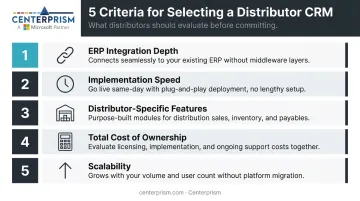
The Five Criteria That Actually Matter
ERP integration depth — Can the CRM sync order history, inventory levels, and customer data without custom development? Native integration beats middleware every time.
Implementation speed — How quickly can your team be operational? Every month of delayed go-live is a month of lost productivity. Ask for a realistic timeline, not a best-case scenario.
Distributor-specific features — Does it handle high-SKU catalogs, territory management, commission structures, and account-based selling? Generic pipeline management won't cover these.
Total cost of ownership — Licensing fees are only part of the number. Factor in implementation, consultant fees, ongoing admin, and add-on modules — then request a full three-year cost estimate before signing.
Scalability — Can the platform grow from your current size to where you're heading? Switching CRMs is expensive — get this right the first time.
The TCO Warning
Of the five criteria above, total cost of ownership is consistently the most underestimated. The licensing fee is just the starting point.
Ongoing costs are where distributor CRM projects quietly fail. Treat it as a process redesign effort — not a software purchase. When sales teams are left out of configuration decisions, and reps are asked to log data without getting better account insight in return, adoption collapses regardless of what the platform cost.
Build your selection process around sales-rep workflow fit, not feature breadth.
Conclusion
The best CRM for a wholesale distributor isn't necessarily the most recognizable brand name. It's the one that matches your operational model, integrates cleanly with your existing systems, and gets your sales team productive without a months-long delay.
For distributors who need an all-in-one solution that works from day one — with integrated ERP, PrismView real-time analytics, automated receivables, and same-day implementation — Centerprism's Full Spectrum ERP is built precisely for this use case. Call 1-800-814-6631 or visit Centerprism to see how it fits your distribution operation.
Frequently Asked Questions
What is the best CRM for wholesalers?
Distribution-specific CRMs outperform generic tools for wholesale operations because they're built around recurring account management, ERP integration, and field sales workflows. The right fit depends on your business size and ERP requirements — for distributors needing same-day deployment with combined ERP and CRM, Centerprism is purpose-built for this segment.
Does CRM include order management?
Most standalone CRMs do not include native order management — that function typically lives in an ERP. Integrated ERP+CRM platforms like NetSuite and Centerprism combine both in one system, giving distributors customer data and order history in one place.
What are the 4 types of CRM for distributors?
The four categories most relevant to distribution are: distribution-specific CRM, all-purpose CRM (Salesforce, HubSpot), ERP-provided CRM (bundled with your existing ERP), and custom-built CRM. DSG data shows distribution-specific tools have the highest satisfaction rates, though general-purpose CRM remains the most widely adopted at 52% of respondents.
What is the difference between a CRM and an ERP for distributors?
A CRM manages customer relationships, sales pipelines, and interactions. An ERP manages back-office operations — inventory, orders, and financials. For distributors, the most efficient setups use a platform that integrates or fully combines both, eliminating the need to reconcile data across two separate systems.
How long does CRM implementation take for wholesale distributors?
It varies widely: all-purpose CRMs like Salesforce typically require months of configuration, while distribution-specific solutions average around 12 weeks. Integrated ERP+CRM platforms with plug-and-play architecture like Centerprism can be operational the same day, because they don't require a separate database layer.
Do wholesale distributors need a mobile CRM?
Mobile access is critical for any distributor with outside sales reps. Field reps need to check account records, order history, and territory data in real time without being tied to a desktop. Look for a purpose-built mobile app with live ERP data access, not a browser-based interface reformatted for a smaller screen.