
Introduction
B2B finance leaders in 2026 are managing revenue data across more channels, sales teams, and reporting periods than ever before — and the tools many organizations still rely on aren't keeping pace. A 2024 study found that 94% of business spreadsheets used for decision-making contain errors, yet manual exports remain the default for distributors, wholesalers, and enterprise finance teams alike.
The problem runs deeper than accuracy. Trintech's global financial close benchmark found that 74% of finance teams had not achieved established or advanced automation maturity, with more than half citing deadline pressure as their top challenge. That's a close-cycle problem rooted in reporting infrastructure.
Modern revenue reporting software has moved well beyond dashboards. Today's best platforms give finance teams real-time visibility into sales trends, receivables, profit margins, and performance — closing the gap that manual infrastructure leaves open.
This guide covers the 10 best revenue reporting software tools for B2B finance in 2026, what sets each apart, and how to choose the right fit for your organization.
Key Takeaways
- Revenue reporting software automates how finance teams track, analyze, and present revenue data across sales trends, receivables, and margin performance.
- Strong platforms include ERP integration, automated reporting, real-time analytics, and compliance support — not just dashboards.
- Top picks span distributors and wholesalers (Centerprism), mid-market ERPs (NetSuite, Sage Intacct), enterprise platforms (SAP, Workday), and subscription-focused tools (Maxio, Chargebee).
- Match your selection to your revenue model and operational complexity — not just brand recognition or peer recommendations.
What Is Revenue Reporting Software?
Revenue reporting software automates the collection, organization, and presentation of a business's revenue data — covering sales performance, profit margins, receivables, deferred income, and financial trends across a given reporting period.
One distinction matters here: revenue reporting and revenue recognition are not the same thing. Revenue recognition software focuses on compliance rules — specifically when income should be recorded under GAAP/ASC 606 or IFRS 15. Revenue reporting is broader. It surfaces actionable insight from that data for planning, performance management, and stakeholder communication.
Many platforms in this list do both. But conflating the two during software selection leads to poor fit.
For B2B finance teams, that distinction has real operational consequences:
- Eliminates manual spreadsheet downloads that produce stale data the moment they're exported
- Reduces close cycle time by giving finance direct access to live metrics
- Gives leadership real-time visibility into gross revenue, net revenue, COGS, and team performance
- Particularly valuable for distributors and wholesalers managing high SKU volumes and complex customer pricing structures
10 Best Revenue Reporting Software for B2B Finance 2026
These tools were evaluated based on real-time reporting depth, B2B finance fit, ERP/CRM integration, implementation complexity, and user trust as reflected on verified review platforms including G2 and Capterra.
Centerprism
Centerprism is a Full Spectrum ERP built specifically for industrial distributors, consumer wholesalers, and rental supply companies in the US. It's one of the few platforms on this list designed from the ground up for distribution — not adapted from a general-purpose accounting tool.
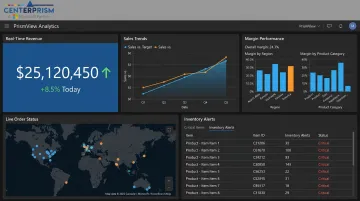
Its PrismView™ analytics tool connects directly to the live Microsoft Dynamics GP database, with no separate data warehouse required. Finance and sales teams get real-time visibility into sales trends, best sellers, profit margins, and salesperson performance without exporting a single spreadsheet.
The commission management module adds another layer of depth: custom plans per salesperson, tiered rates, paid invoice commissions, product spiffs, and a sliding depreciation scale that adjusts commissions based on the aging of past-due invoices — directly linking collections accountability to compensation.
Implementation speed sets Centerprism apart from every other tool on this list. No separate BI database setup required — the system installs and goes live the same day.
| Best For | Distributors and wholesalers needing same-day ERP deployment with built-in real-time revenue reporting |
| Key Features | PrismView real-time analytics, automated receivables and collections, integrated CRM, sales commission management, credit card processing |
| Pricing | Contact Centerprism at 1-800-814-6631 for a custom quote |
NetSuite Advanced Revenue Management
NetSuite is Oracle's cloud ERP platform, used by more than 43,000 customers across mid-market and enterprise B2B organizations. Its Advanced Revenue Management (ARM) module automates revenue scheduling, allocation, forecasting, and auditing through a rule-based event framework.
Multi-book accounting, dynamic SSP definitions, and real-time forecasting dashboards make it a strong fit for companies that need to consolidate revenue data across multiple subsidiaries, currencies, and contract types. NetSuite supports ASC 606, IFRS 15, and other global standards natively.
Capterra rating: 4.2/5 (2,045 reviews). G2 rating: 4.1/5 (3,956 reviews).
| Best For | Mid-market to enterprise companies needing multi-entity revenue consolidation within an ERP |
| Key Features | Multi-book revenue recognition, dynamic SSP definitions, real-time forecasting, multi-currency support |
| Pricing | Annual license (platform + modules + users); contact NetSuite for a custom quote |
Sage Intacct
Sage Intacct is a cloud-based financial management platform designed for compliance-heavy finance teams that need accurate, audit-ready revenue reporting with faster monthly closes. It's especially popular with multi-entity B2B companies preparing for external investment or audits.
Key capabilities include AI-powered anomaly detection, automated revenue and expense reallocation, and support for both ASC 606 and IFRS 15. Sage also offers over 600 billing scenarios and a bidirectional Salesforce integration for order, customer, and contract data.
G2 rating: 4.3/5 (4,178 reviews).
| Best For | Compliance-heavy B2B finance teams and multi-entity organizations |
| Key Features | ASC 606/IFRS 15 support, AI-driven anomaly detection, custom reporting templates, automated revenue reallocation |
| Pricing | Custom pricing; contact Sage Intacct for a consultation |
SAP S/4HANA Cloud
SAP S/4HANA Cloud is the enterprise standard for organizations already embedded in the SAP ecosystem. It covers the full lead-to-cash lifecycle — pricing, billing, recognition, and reporting — with real-time data processing and AI-powered billing tools.
SAP Billing and Revenue Innovation Management supports high-volume billing, invoicing, and financial posting with native S/4HANA integration. The platform also integrates with SAP Commerce Cloud for end-to-end order management.
Implementation complexity is significant — it's built for large enterprises already running SAP infrastructure, not first-time ERP adopters.
Capterra rating: 4.3/5 (358 reviews).
| Best For | Large enterprises running SAP ecosystems needing unified revenue reporting |
| Key Features | Real-time ERP reporting, AI billing assistants, subscription lifecycle management, CPQ capabilities |
| Pricing | Price upon request; contact SAP for a tailored quote |
Salesforce Agentforce Revenue Management
Formerly Revenue Cloud, Salesforce Agentforce Revenue Management is a product-to-cash platform built natively on Salesforce CRM. It connects sales, finance, and legal around a single source of revenue data, with embedded AI agents to automate quoting, billing, and reporting workflows.
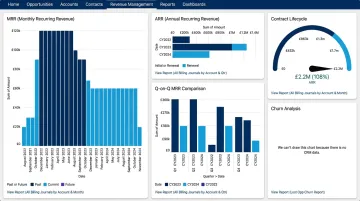
Contract amendments, renewals, and order changes flow automatically into billing and revenue reporting. Tableau-powered analytics provide real-time visibility into MRR, ARR, and revenue metrics across the entire customer lifecycle.
Capterra rating: 4.4/5 (82 reviews).
| Best For | B2B companies already on Salesforce CRM needing integrated quote-to-cash revenue reporting |
| Key Features | Native CRM integration, CPQ, contract lifecycle management, MRR/ARR tracking, Tableau analytics |
| Pricing | Revenue Cloud Growth from $150/user/month; Revenue Cloud Advanced from $200/user/month (billed annually) |
Workday Financial Management
Workday Financial Management is a full-suite cloud ERP for global enterprises. Revenue reporting is part of a broader platform that includes accounts receivable, close and consolidation, and cross-entity analytics — with multi-GAAP and multi-currency support built in.
Workday AI identifies journal anomalies and provides actionable recommendations. The platform also integrates with Salesforce CRM for cross-system revenue visibility.
G2 rating: 4.2/5 (280 reviews).
| Best For | Global enterprises requiring multi-entity, multi-currency, and multi-GAAP revenue reporting |
| Key Features | Multi-book accounting, AI anomaly alerts, Salesforce CRM integration, drill-down analytics |
| Pricing | Custom pricing; contact Workday for a tailored quote |
QuickBooks Online Advanced
QuickBooks Online Advanced is the upgraded tier of Intuit's accounting platform — adding revenue scheduling, deferral tracking, and recognition automation for small to mid-size B2B companies that need more than basic bookkeeping.
Automated recognition schedules tie to delivery milestones, and built-in income and deferred revenue reports support month-end close. For teams already in the QuickBooks ecosystem, it adds structured revenue reporting without requiring a platform migration.
Capterra rating: 4.4/5 (1,045 reviews). G2 rating: 4.5/5 (311 reviews).
| Best For | SMBs and growing B2B companies already using QuickBooks seeking revenue reporting upgrades |
| Key Features | Revenue scheduling, deferral tracking, milestone-based recognition, month-end reporting, ASC 606 support |
| Pricing | $275/month |
Maxio
Maxio (the result of merging SaaSOptics and Chargify) is purpose-built for B2B companies with subscription or usage-based revenue streams. It automates recognition schedules, tracks SaaS metrics in real time, and handles complex recurring revenue models including upgrades, downgrades, and contract modifications.
Line-item level revenue reporting, automated waterfall reports, and configurable recognition rules make it particularly strong for finance teams managing ARR/MRR at scale.
Capterra rating: 4.3/5 (255 reviews). G2 rating: 4.3/5 (829 reviews).
| Best For | B2B SaaS and subscription businesses needing automated revenue reporting with MRR/ARR tracking |
| Key Features | Line-item recognition, waterfall reports, churn and expansion metrics, ASC 606/IFRS 15 compliance, real-time SaaS dashboards |
| Pricing | Grow plan from $599/month (up to $100k monthly billings); Scale plan requires custom pricing |
Chargebee
Chargebee automates recurring revenue reporting, invoice generation, and payment reconciliation — integrating into major ERPs and accounting systems to centralize revenue data for finance teams.
It supports multiple pricing models (tiered, usage-based, flat-rate) and generates audit-ready revenue recognition and deferred revenue reports compliant with GAAP/ASC 606 and IFRS 15. Its NetSuite integration specifically bridges subscription billing and accounting to improve order-to-cash workflows.
G2 rating: 4.4/5 (978 reviews).
| Best For | B2B companies with recurring revenue models needing automated billing and revenue reporting |
| Key Features | Subscription lifecycle management, multi-model pricing, auto-invoicing, revenue analytics, ERP and CRM integrations |
| Pricing | Starter: $0/month for the first $250k cumulative billing, then 0.75% overage; Performance: $7,188/year (billed monthly, up to $100k billing/month); Enterprise: custom |
Mosaic
Mosaic is a strategic finance platform for FP&A teams that need real-time revenue reporting without requiring engineering resources. It connects to ERP, CRM, billing, and HRIS systems through 30+ pre-built integrations, pulling data into a unified reporting layer.
Prebuilt revenue metrics dashboards and scenario planning tools replace manual spreadsheet-based reporting with live data. It's especially useful for B2B finance teams that need board-ready revenue reports without waiting for IT.
G2 rating: 4.6/5 (217 reviews).
| Best For | B2B finance and FP&A teams needing real-time revenue reporting and strategic planning in one platform |
| Key Features | Real-time revenue dashboards, scenario planning, ERP/CRM/billing integrations, automated financial reporting, no-code setup |
| Pricing | Not publicly listed; contact Mosaic for a custom quote |
How We Chose the Best Revenue Reporting Software
Tools were assessed on their ability to deliver real-time revenue visibility, the depth of their reporting features, and practical fit for B2B finance — not just marketing claims.
Capterra's 2024 U.S. Tech Trends Report found that 58% of U.S. buyers regretted at least one software purchase in the prior 12-18 months, with 56% describing the financial impact as significant or monumental. Mixed IT and non-IT buying teams had lower regret rates (54%) than teams making decisions without cross-functional input. These findings shaped how evaluation criteria were weighted.
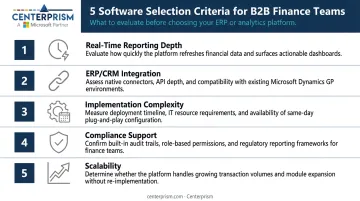
The five core selection factors:
- Real-time reporting depth — Does the platform surface live data, or require scheduled exports? Faster access cuts close cycle time directly.
- ERP/CRM integration — Can it connect to existing systems without heavy engineering? Gaps here create data silos that compound over time.
- Implementation complexity — How long before the platform is actually useful? Long onboarding delays time-to-value and increases internal adoption risk.
- Compliance support — Does it handle ASC 606 and IFRS 15 where relevant? Missing this creates audit exposure.
- Scalability — Will it grow with the business, or require replacement at the next funding or growth stage?
Three secondary factors also influenced rankings:
- Pricing transparency (published tiers vs. quote-only models)
- Verified user review scores from G2, Capterra, and similar platforms
- Industry fit — particularly for distribution and wholesale operations
The right tool should align with your operational model and revenue structure, not just your budget.
Conclusion
The best revenue reporting software for B2B finance in 2026 depends on your industry, revenue model, existing tech stack, and how quickly you need to go live.
When shortlisting options, go beyond feature comparisons. Evaluate each tool on:
- Implementation speed and actual time-to-value
- Fit with your existing tech stack (ERP, CRM, billing)
- Finance and IT alignment — involve both teams before committing
- Ongoing support and vendor responsiveness post-launch
Request demos with your real data scenarios, not scripted walkthroughs.
If those criteria matter to you and you're running distribution or wholesale operations, Centerprism is worth a close look. Built on Microsoft Dynamics GP, it includes PrismView™ for real-time revenue analytics — no separate BI database needed — alongside integrated sales management, commissions, and receivables. Same-day implementation means you're not waiting months to see results. Call 1-800-814-6631 to schedule a demonstration.
Frequently Asked Questions
What is revenue reporting software?
Revenue reporting software automates the collection and presentation of a company's revenue data — covering sales performance, margins, receivables, and trends. Finance teams use it to make faster, more accurate business decisions without relying on manual spreadsheet exports.
How is revenue reporting software different from revenue recognition software?
Revenue recognition software focuses specifically on recording income under GAAP/ASC 606 or IFRS 15 rules. Revenue reporting software is broader — it encompasses dashboards, analytics, and financial reporting across all revenue streams. Many platforms in this list do both, but they serve distinct purposes.
What features should B2B finance teams prioritize in revenue reporting software?
Focus on real-time analytics dashboards, ERP/CRM integration depth, automated reporting, audit trails, and support for your specific revenue model — whether that's subscription billing, distribution, project-based, or usage-based revenue.
Do small or mid-size distributors need dedicated revenue reporting software?
Yes — especially those managing complex pricing, multiple sales reps, or high SKU volumes. Manual spreadsheets introduce errors and delay financial decisions. Even entry-level tools like QuickBooks Online Advanced provide meaningful automation over unstructured reporting.
How does revenue reporting software integrate with existing ERP systems?
Most platforms connect via native integrations, open APIs, or pre-built connectors to popular ERPs like NetSuite, SAP, and QuickBooks. Fully integrated ERPs like Centerprism consolidate reporting and operations in one system, removing the need for separate connectors entirely.
What is the typical cost of revenue reporting software for B2B companies?
Costs range widely — from $275/month for QuickBooks Online Advanced to $599/month for Maxio's Grow tier, to custom enterprise pricing for SAP, Workday, and NetSuite. When comparing platforms, look beyond the subscription fee — implementation, integrations, user seats, and training all affect total cost of ownership.