Warehouse automation is how leading distributors are responding. Not by replacing their entire workforce with robots, but by deploying the right combination of software, hardware, and data systems to move more orders with greater accuracy and less manual effort.
This article covers what warehouse automation actually is, how it works from a systems perspective, the core technologies involved, and the trends shaping where it's heading—framed specifically for distribution and wholesale businesses evaluating their next step.
Key Takeaways
- Warehouse automation combines software and physical technologies to move inventory from receiving to shipping with minimal manual effort
- A software layer—WMS or ERP—acts as the central nervous system connecting all physical systems in real time
- Core technologies include AS/RS, AGVs, AMRs, conveyor systems, and picking solutions—each suited to different operations
- Higher throughput, lower labor costs, better inventory accuracy, and faster order fulfillment are the primary gains
- AI, IoT, robotics, and ERP integration are the dominant trends reshaping warehouse operations right now
What Is Warehouse Automation?
Warehouse automation is the use of software, robotics, and connected technology systems to perform inventory movement and management tasks—receiving, storage, picking, packing, and shipping—with reduced human intervention. Most operations still rely on people; automation handles the repetitive, high-volume tasks where speed and accuracy matter most.
From Basic to Advanced
At the basic end, automation means barcode scanners and inventory software replacing clipboards and manual counts. At the advanced end, it means AI-driven robotics, autonomous mobile robots, and fully integrated systems that route, track, and fulfill orders without a human touching the process at all. Most real-world operations sit somewhere in the middle—and that's intentional.
The practical value of this spectrum is that distributors can start where their budget and operations allow, then build from there.
Why It's Become a Strategic Priority
The warehouse automation market was valued at USD $34.17 billion in 2026 and is forecast to reach $65.74 billion by 2031, growing at a 13.98% CAGR. High-volume distribution operations now treat it as core infrastructure, not an optional upgrade.
The primary drivers are straightforward:
- E-commerce growth has compressed fulfillment windows and multiplied order complexity
- Labor shortages have made it harder to scale headcount in step with volume
- Customer expectations for same-day or next-day delivery have raised the baseline for what "acceptable" fulfillment looks like
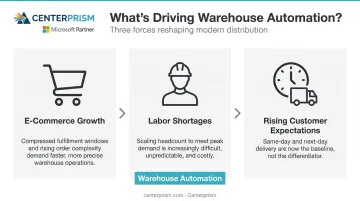
Distributors, wholesalers, 3PLs, and manufacturers with high order volumes and repetitive workflows feel these pressures most directly. For them, automation isn't a future consideration—it's an active competitive lever.
How Does Warehouse Automation Work?
When an order is placed, the automated warehouse responds in layers. The software side routes the order, assigns a pick location, and reserves inventory. The physical side (robots, conveyors, sorters) executes the movement. Meanwhile, sensors and scanners capture every transaction, update inventory records automatically, and confirm fulfillment in real time. The loop closes without a paper trail or manual entry.
Digital vs. Physical Automation
Digital automation handles the data side: automatic inventory tracking, order routing, barcode and RFID scanning, and real-time record updates. This is the first step for most distributors moving toward automation — lower cost, faster to implement, and capable of delivering measurable accuracy gains before a single robot is deployed.
Physical automation handles the movement side: conveyors, sorters, robotic systems, and autonomous vehicles that execute instructions issued by the software layer. Physical automation without accurate digital data is unreliable. The two work as a system, not independently.
The Software Layer: WMS, WES, and WCS
The software architecture of an automated warehouse typically includes three distinct layers:
| Layer | Role |
|---|---|
| WMS (Warehouse Management System) | Manages inventory, orders, receiving, picking, packing, and shipping |
| WES (Warehouse Execution System) | Orchestrates workflows between planning and equipment execution |
| WCS (Warehouse Control System) | Sends real-time commands to physical equipment |
For distributors, the real operational advantage comes from connecting this software stack to a broader ERP platform. Centerprism's ERP, built on Microsoft Dynamics GP, adds a Wireless Warehouse module that supports barcode scanning and live inventory updates directly from the warehouse floor.
Its PrismView™ analytics tool connects directly to the GP database — no separate database required — so operations teams always work from current data, not a static export. When a sales dashboard flags a demand surge on a specific SKU, warehouse managers can adjust picking priorities and replenishment triggers before a stockout ever occurs.
Types of Warehouse Automation Technology
Physical Automation Technologies
Automated Storage and Retrieval Systems (AS/RS) Robotic cranes or shuttles that store and retrieve goods from high-density shelving. MHI defines AS/RS as equipment and controls that automatically handle, store, and retrieve materials with precision, accuracy, and speed. Best suited for space-constrained distribution centers looking to maximize vertical storage and cut retrieval time.
AMRs vs. AGVs Automated Guided Vehicles (AGVs) follow fixed, predefined routes. Autonomous Mobile Robots (AMRs) navigate dynamically using sensors and AI—no fixed paths required. Interact Analysis forecasts the mobile robot market will grow at 19% annually to 2030, while AGV revenue share is expected to drop from roughly 33% in 2024 to 20% by 2030. For complex, high-traffic distribution environments, AMRs offer far more flexibility.
Conveyor and Sortation Systems Automated belts transport goods between zones and divert them to correct locations using RFID or barcode scanners. These systems connect receiving, picking, packing, and shipping into a continuous flow, with high-throughput sortation handling thousands of items per hour.
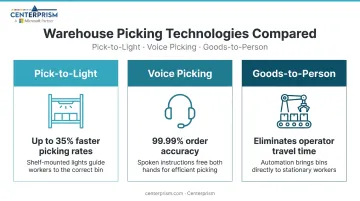
Picking Technologies For high-SKU distribution operations, picking accuracy and speed are often the highest-ROI targets:
- Pick-to-light — shelf-mounted lights guide workers to the correct bin, reducing mis-picks
- Voice picking — headsets deliver spoken instructions, freeing both hands; Honeywell states voice picking can increase productivity by more than 30% and reach 99.99% order accuracy
- Goods-to-person (GTP) — automation brings inventory bins to stationary workers, eliminating travel time across large facilities
Software and Systems
The WMS/WES/WCS stack forms the control architecture of any automated warehouse:
- WMS (Warehouse Management System) — handles inventory tracking and order management
- WCS (Warehouse Control System) — controls physical equipment in real time
- WES (Warehouse Execution System) — bridges the two, orchestrating labor and automation workflows simultaneously
Modern platforms increasingly consolidate these functions into unified systems. That consolidation creates a natural integration point: connecting the warehouse software stack to an ERP that holds live sales, purchasing, and customer data. For distributors and wholesalers, that connection is where automation pays off most. When fulfillment decisions run on real-time business data—not a stale export from the night before—the entire operation becomes more accurate and more responsive.
Key Benefits of Warehouse Automation
Throughput and Fulfillment Speed
Automation eliminates the manual bottlenecks that slow picking, cause misrouting, and generate paper-based delays. A Locus Robotics and Staples Canada case study reported 2x productivity gains and a 73% improvement in order accuracy after deploying AMRs—alongside a 70% reduction in training time for new workers.
Inventory Accuracy and Cost Reduction
Real-time RFID and barcode tracking prevents overstocking, stockouts, and the labor cost of manual cycle counts. A Kardex survey of 127 warehouse and distribution center leaders found 65% said automation met or exceeded their ROI expectations, with only 10% reporting it fell short.
Those returns compound over time. Long-term cost savings typically come from:
- Lower labor costs as throughput scales
- Fewer order errors reaching customers
- Reduced carrying costs through tighter inventory visibility
Worker Safety and Scalability
Automation handles hazardous tasks—heavy lifting, high-shelf retrieval—that create injury risk. Cloud-based systems allow operations to scale throughput during peak seasons without proportional headcount increases. For distributors with seasonal demand spikes, that scalability can be the difference between meeting order volume and falling behind it.
Key operational advantages include:
- Injury reduction: Robots handle high-risk physical tasks
- Seasonal flexibility: Scale throughput without proportional hiring
- Consistent performance: Automated systems don't fatigue or make shift-end errors
Common Challenges of Warehouse Automation
High Upfront Cost
The total cost of automation varies widely—equipment scope, facility size, SKU profile, and software integration requirements all shift the number. No single benchmark applies across operations.
A practical ROI calculation compares:
- Current labor costs and projected savings post-automation
- Error rates and the downstream cost of fulfillment mistakes
- Throughput ceilings and the revenue impact of removing them
For businesses not ready for full capital expenditure, Robots-as-a-Service (RaaS) models offer a subscription-based path to deploying AMRs without upfront hardware ownership.
Integration Complexity
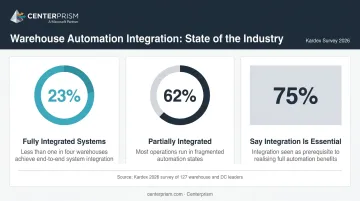
A Kardex 2026 survey of 127 warehouse and DC leaders found only 23% had fully integrated systems, while 62% were partially integrated—yet 75% said integration is essential to achieving automation benefits. Systems that don't connect cleanly create data silos that defeat the purpose of automation.
Choosing platforms with proven ERP compatibility and clean data interfaces reduces this risk considerably. For distributors running Microsoft Dynamics GP, Centerprism connects directly to the GP database without requiring a separate data warehouse, keeping integration straightforward from day one.
Workforce Transition
Automation shifts roles, it doesn't simply eliminate them. Workers move from repetitive physical tasks into supervision, quality control, and system management—roles that require different training but remain essential.
Companies that invest in structured retraining and change management during rollout consistently see better adoption outcomes than those who treat the transition as a purely technical project.
Key Warehouse Automation Trends to Watch
AI and Machine Learning
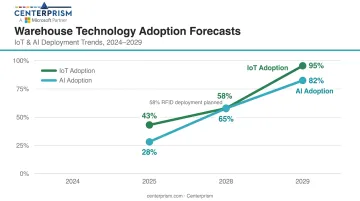
AI is the most significant capability shift underway in warehouse operations. MHI's 2025 Annual Industry Report forecasts AI adoption rising from 28% in 2025 to 82% by 2029. McKinsey reports that AI-enabled demand forecasting can reduce inventory levels by 20% to 30% through dynamic segmentation and machine learning.
Within warehouse operations, AI drives measurable efficiency gains across several functions:
- Predictive replenishment — triggers restocking based on demand signals, not fixed schedules
- Dynamic route optimization — adjusts AMR paths in real time as pick volumes shift
- Demand-driven labor allocation — matches staffing to forecasted workload without manual planning
IoT Expansion and Real-Time Visibility
IoT sensors and RFID are providing precise, real-time location data on both inventory and equipment. MHI 2024 reports 43% current IoT adoption with 42% planned—near-universal deployment within a few years. For distributors managing high SKU counts, IoT-connected warehouses enable predictive maintenance (flagging equipment issues before failure) and continuous inventory visibility across every zone. Zebra's 2023 study found 58% of warehouse decision-makers planned to deploy RFID by 2028.
ERP Integration and End-to-End Automation
Automation is moving beyond the warehouse floor. Distributors are now connecting fulfillment execution directly to sales, purchasing, and customer service data in real time. Distributors that unify warehouse execution data with back-office ERP gain a measurable advantage: fulfillment decisions reflect actual sales trends and purchase order status, not delayed batch updates. For high-SKU distributors, that real-time connection is the difference between reacting to stockouts and preventing them.
Frequently Asked Questions
How much does an automated warehouse cost?
Costs vary widely based on scope—digital automation such as barcode systems and inventory software can start in the tens of thousands, while full physical automation involving robotics, AS/RS, and conveyors can run into the millions. Calculate ROI by weighing your current labor costs, error rates, and throughput limits against projected savings and implementation costs.
What is automated warehouse management?
Automated warehouse management uses software—typically a WMS or ERP—combined with physical technologies like robots and conveyors to oversee all warehouse processes with minimal manual intervention. This includes inventory tracking, order routing, receiving, picking, packing, and shipping, all updated in real time.
What is an example of an automated warehouse system?
A goods-to-person setup is a common example: AMRs retrieve inventory bins and deliver them to stationary workers at pick stations, eliminating travel time and reducing pick errors. AS/RS systems—where robotic cranes store and retrieve pallets from high-density shelving—are another widely deployed option.
What are the four types of WMS?
The four common types are standalone WMS, ERP-integrated WMS, cloud-based WMS, and supply chain management (SCM) suite modules. ERP-integrated and cloud-based options are preferred for real-time visibility, scalability, and tighter integration of warehouse execution data with broader business systems.
Can small or mid-size distributors implement warehouse automation?
Yes. Mid-market distributors and wholesalers can start with digital automation—barcode scanning, inventory software, and ERP integration—before committing to physical robotics. This phased approach keeps initial investment manageable while delivering meaningful accuracy and visibility gains that build the case for further automation.
Does warehouse automation replace human workers?
Automation shifts human roles rather than eliminating them. Workers move from repetitive physical tasks—picking, sorting, manual counting—to supervision, quality control, and system management. Most successful implementations operate on a human-machine collaboration model where automation handles volume and consistency while people handle exceptions and oversight.